
FCOA CLIMBER PROGRAM
Elevate Your Skills with the FCOA Climber Program
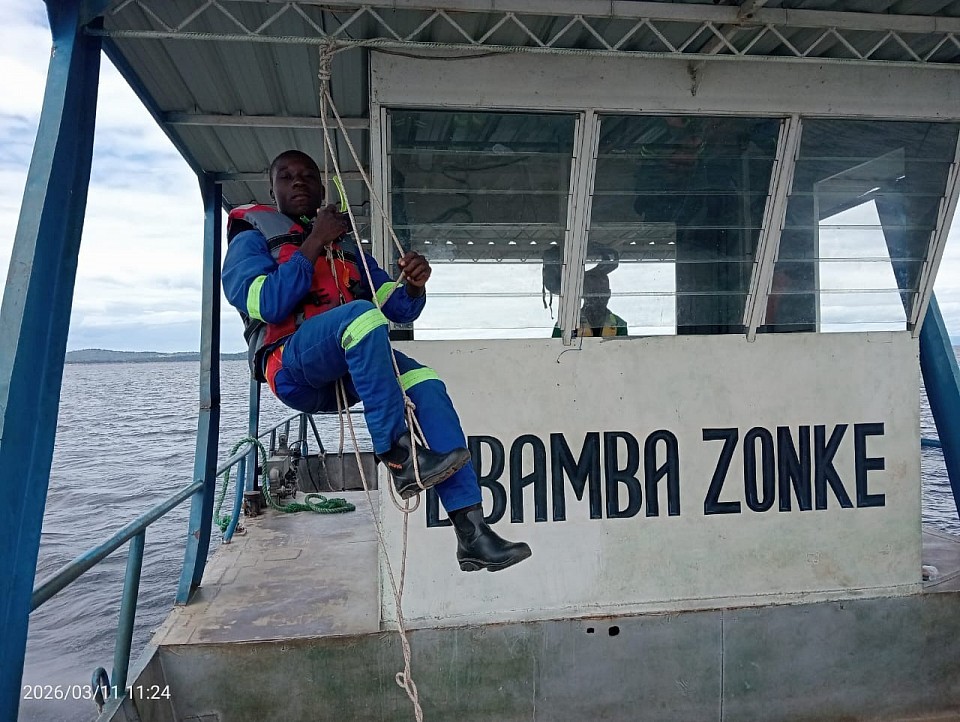
Improvised Climb training on the move
The FCOA Climber Program offers a structured approach to learning rock climbing, starting with the FCOA Improvised Climber program and progressing through various levels, including Top Rope, Lead, Rescue, and Instructor courses. Each level builds on skills learned in the previous one, emphasizing safety, improvisation, and practical techniques.
Our introduction program to climbing is called "FCOA Improvise Climbing"
Progression:
Once you have completed the FCOA Improvised Climber program, you can continue practicing your new skills till you can do them blind folded or in the dark. Once you're able to do that you can start your next trainings:
FCOA TOP ROPE CLIMBER
FCOA LEAD CLIMBER
FCOA RESCUE CLIMBER
FCOA CLIMBING INSTRUCTOR
About the FCOA Improvised climb training:
Most people in the world don't have access to specialized climbing gear. Also, when you're on top of a burning building, you will just have to use what is available, so being able to improvise can save your life. For this training, all you need is a random 15 meter rope from your local hardware store. (Ø 10 mm)
180.000 people per year die due to fires. Many could have saved themselves if they would have been able to rappel from their burning building
Risk Management:
During this training we recommend to not climb higher then 2 meter and to keep an old mattress under your climbing area. The development of climbing skills takes time. It's good to practice new skills close to the ground. Use common sense and develop your judgement. Take responsibility of your own safety and don't just trust anyone till that trust has been earned.
This improvised climb training is available for anyone that can get online and is meant to reduce the risks involved in our natural climbing journey. This training is somewhat different than most other trainings where they will be very specific about what specialized equipment to use.
We humans are primates and just like Orangutans and Chimpanzees, it's in our genetics to develop climbing skills. By doing so we can reach the best fruits and stay away from the wolves. Sometimes we fall, get injured and some even die, but most of the time we just bruise and evolve. As much as possible learn from mistakes that are already made by others. Good for you if you can find a climbing instructor. But if not, don't let it stop you from practicing improvised climbing basics at home.
How come a freediving organization teaches climbing?
This program came to exist for 2 reasons.
1. Climbing skills are now an additional prerequisite for FCOA lifeguard certification. This will aid rescues from water wells and high ships.
2. Its now also a prerequisite for FCOA solo sailor certification. Since sailors occasionally have to climb in their masts.
The training modules for climbing are available on fcoa.online under digital training.
FCOA Improvise Climbing
This introductory program focuses on developing climbing skills using minimal equipment. Participants learn to improvise with basic materials and practice essential skills such as rappelling, prusiking, bouldering, and belaying. Safety is a priority, with recommendations to practice close to the ground and take responsibility for personal safety.
Prerequisite:
This training requires a serious mindset. Attendees have to be able to take responsibility for their own safety and the safety of those around them. :
Passing requirement:
To complete this program you have to practice the following skills at least once:
- Rapeling (coming down a rope)
- Prusiking (going up a rope)
- Boldering (Horizontal climb training)
- Belaying (Safeguarding a climber with a rope)
Once you have practiced those four skills you may request for your FCOA Improvised Climber Certificate of attendance from the coach that trained you.
Risk Management:
During this training we recommend to not climb higher then 2 meter and to keep an old mattress under your climbing area. The development of climbing skills takes time. It's good to practice new skills close to the ground. Use common sense and develop your judgement. Take responsibility of your own safety and don't just trust anyone till that trust has been earned.
This improvised climb training is available for anyone that can get online and is meant to reduce the risks involved in our natural climbing journey. This training is somewhat different than most other trainings where they will be very specific about what specialized equipment to use.
We humans are primates and just like Orangutans and Chimpanzees, it's in our genetics to develop climbing skills. By doing so we can reach the best fruits and stay away from the wolves. Sometimes we fall, get injured and some even die, but most of the time we just bruise and evolve. As much as possible learn from mistakes that are already made by others. Good for you if you can find a climbing instructor. But if not, don't let it stop you from practicing improvised climbing basics at home.
Some Definitions
Top rope climbing: This is the safest way of climbing with a rope from the top, if you slip or fall, right away you're hanging in the rope.
Free style climber. Any climber that climbs without specifically agreeing with a competent belayer to be belayed.
Lead climbing: the first person to go up to deploy a rope. This is at a higher risk, when falling the climber will fall twice the height that he is above his last anchor.
A competent belayer (FCOA definition): A belayer that has at least 3 times responded appropriately to your unannounced fall in the last year with the equipment types and environment he/she is familiar with
Backup Belayer: An experienced belayer that assist when the primary belayer is still developing his skills. The back up belayer will hold the rope that comes from the belayer so in case the belayer lets go, the backup belayer will prevent the climber from falling.
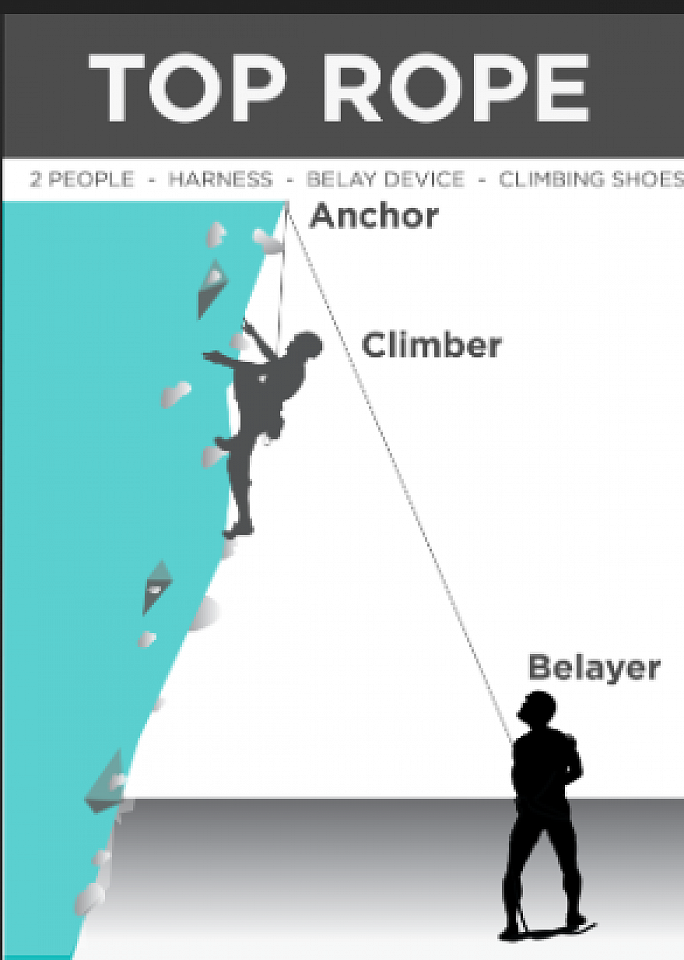
Top rope climber on belay
FCOA TOP ROPE CLIMBER course
This course teaches one of the safest climbing methods, where the rope is anchored at the top. Participants must master various knots and safety techniques. The course covers equipment care, climbing techniques, and the importance of using certified gear to minimize risks.
Top rope climbing is one of the safest and most accessible forms of climbing. The rope runs from your harness, up to an anchor at the top of the route, and back down to a belayer on the ground. This setup minimizes fall distance and is ideal for learning technique, building strength, and gaining confidence.
Prerequisites
- You have completed the FCOA improvised climbing quize
- You have further trained yourself to do the following knots with your eyes closed: Clove hitch, Bowline, Double eight, Italian Hitch, Cow Hitch, Over hand hitch, Granny knot, Reef knot, Prusik knot.You can transition from Prusik to Self-belay without slipping.
During the FCOA Improvised Climb Training you learned how to rappel, prusik and give belay during emergencies. Outside of emergencies there are many detailed safety habits climbers have developed to minimize risk.
The biggest difference between what you learned during improvised climbing and sport climbing are the following. Most climbers only use certified climbing equipment and only use it in accordance with the manufacturer's recommendations.
Ropes and harnesses often get retired after 10 years or after a certain number of uses. Climbers care for their expensive ropes. They prefer devices that are the most gentle on their ropes. They would avoid rappelling with an Italian hitch because it twists and turns the rope. Even a figure of eight still twists the rope. ATC's are preferred.Climbers don't like people to stand on their ropes. It can push sand and dirt trough the outer core, and also: lead climbers sometimes put the rope in their mouth before clipping into the next quick draw, so that is extra reason to keep the rope clean.
They would use double anchor points just in case one breaks out. They tie double eight knots on their belay loops. They are particular about the knots they use. They would never say: If you don't know how to tie knots, tie lots. They stick to well thought trough proven effective and safe habits.
COURSE TOPICS
- Equipment & Further knots
- Different anchors
- Giving and taking belay Climbing Technique
- Falling practice
Requirements to meet to become a certified FCOA TOP ROPE climber:
- You must have completed the FCOA TOP ROPE CLIMBER quiz
- You must be able to make the additional knots with your eyes closed
- You must be able to create safe anchor points
- You must be able to give safe belay also when you have no vision of the climber
- As a climber you must have shown 3 intentional falls
- As a belayer you must have responded appropriately to 3 unannounced falls
- You must have participated in training 2 members for Improvised Climbing. If your an FCOA coach, you must have certified them for it.
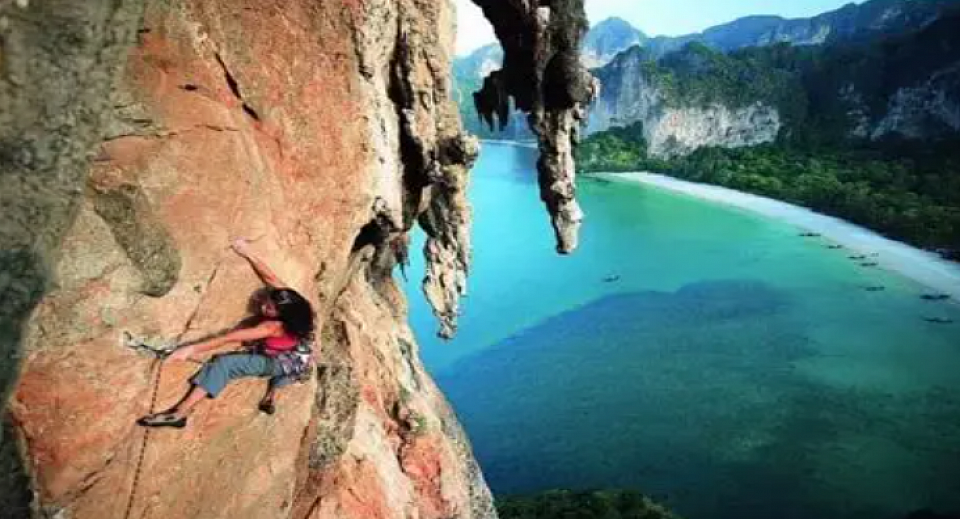
Lead climber on a cliff
FCOA LEAD CLIMBER course
Lead climbing involves higher risks as climbers establish their own anchors. This course requires prior completion of the Improvised Climber and Top Rope courses, along with additional training in first aid and climbing techniques. Emphasis is placed on risk assessment and proper fall techniques.
Prerequisites
- You have completed the FCOA improvised Climber Course.
- You have completed FCOA medic fist air or an equivalent course.
- You have completed the theory FCOA lesson 8 "LOST"
- You are a competent safety and have climbed for at least 2 days
- Additional knots
Spanish Bowline
Portuguese bowline
Sliding X
Butterfly knot
Double Fishermans knot
Lead climbers are exposed to higher risk, top rope climbers already have an established rope that allows them to let go from the rock with a minimum falling distance.
Lead climbers are the once that establish the top rope. While climbing up they clip in to anchor points, as they climb above their anchor points, when they fall, they will fall twice the distance that they got above the anchor point before the rope catches them.
Risk Assessment
Lead climbing has the highest risk near the ground. The first few meters you will have no rope protection yet. In case you fall or jump your belayer can only guide your landing and stop you from further rolling down the hill. Once you are clipped into your first anchor point you have some rope protection but as you climb above it that protection greatly reduces. There for it's good to have the first few anchor points near each other. The higher you get the more rope protection you have. Once your 8 anchor points up, you could fall, your last anchor point could break out and the next one would catch you without you coming to near the ground. When climbing repetitively visualize how your fall would play out. If you're not exactly above your anchor point then after your fall you will swing. What will you swing in to?
When lead climbing the equipment is prone to shock loading and stretch. Make sure to understand the fall factor.
FALLING
Notes of caution for lead climbers: As a lead climber, you need to be prepared for a fall at any moment. Here are two things you can control once you fall.
Eyes: Your eyes dictate the movements of your body. If you barn-door off the wall and look over your shoulder while rotating away from the wall, your body is likely to follow. Instead, when you fall, look down between your legs at the wall, which will help orient your body in a position better suited to a soft landing.Body Position: After you fall, your goal should be to end up in a sitting position. When you come in contact with the wall, your feet are ideally planted a little more than hips-width apart, knees bent to absorb the impact. Hands may be up in front of your face to protect it against large holds or roofs, but should otherwise not be involved in bracing the fall.
Rope in mouth: Lead climbers often put the climbing rope in their mouth while they are clipping in to their next anchor points. If you slip and fall be sure to spit the rope out.
Lean from the mistakes of others: Five recorded casualties to learn from most accidents happen during the routine parts of the journey.
Competent belayer
Don't trust to easily. If as a lead coach you have not yet build trust with your belayer then climb at a place that looks like a staircase to you. A place where you are not going to fall. There you can simulate some falls and unannounced jumps to build trust.
The FCOA definition of a competent belayer:
A belayer that has at least 3 times responded appropriately to your unannounced fall in the last year with the equipment types and environment he/she is familiar with.
When you start using new equipment you are no longer a competent belayer. You have to again respond to some unannounced falls to experience how this equipment handles the forces.
When you start climbing in a new sort of environment you are also no longer a competent safety. Your first time climbing in cold or snowy conditions or your first time belaying in a dark cave. Again, you should practice some responses to unannounced falls.
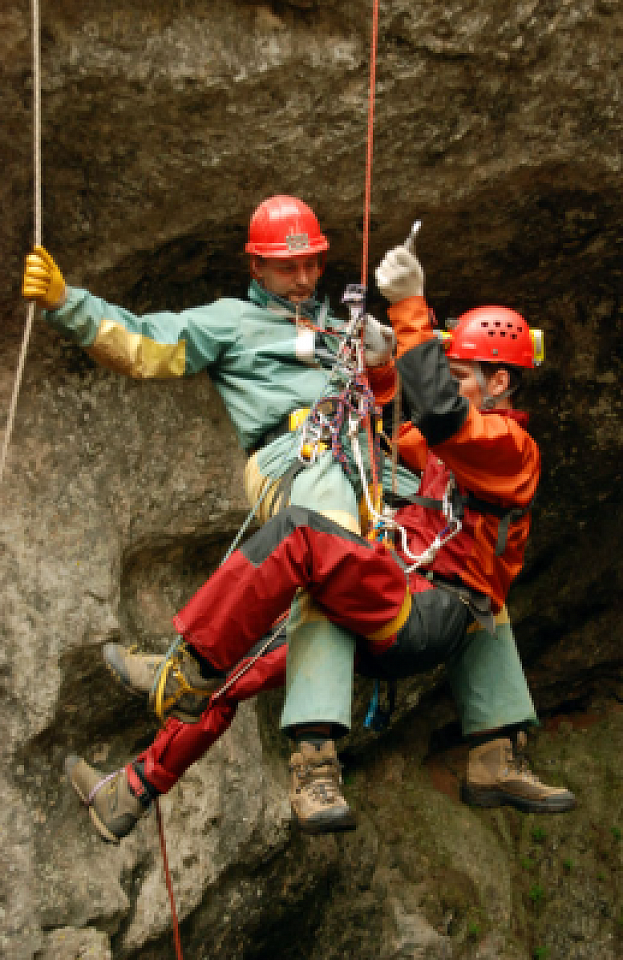
Rescue Climber and Victim
FCOA RESCUE CLIMBER
This advanced course prepares climbers for rescue situations. Participants must complete several prerequisites and demonstrate skills in safely bringing down an unconscious climber and lifting a victim using a pulley system. Time management and effective techniques are critical in emergency scenarios.
Prerequisite
You have completed the following:
- FCOA improvised climber
- FCOA TOP ROPE CLIMBERFCOA LEAD CLIMBER
- FCOA Lesson 3 Navigation
- FCOA Lesson 5 A Coach training
- FCOA Lesson 5 B Medic First Aid
- FCOA Lesson 8 Lost at Sea (On use of coordinates, same as lost in the jungle)
- FCOA lesson RADIO Operator (Under Sailing)
Passing criteria
- Able to bring down an unconscious climber (or dummy) on a free hanging rope in less than 15 minutes.
- The fastest solution here could be to use a second rope to rappel next to the unconscious climber, clip his harness to yours, cut his rope and descend. But we like to practice worst case scenarios, so for our practiced: you have to climb up the same rope that the unconscious climber is hanging on. You somehow have to get above him, connect him to your harness and find a way to leverage him up to undo his belay devise. Your not allowed to cut ropes.
- Time is of the essence in this exercise. Once a climber is hanging unconscious in his harness his muscles will relax and the harness cuts of the blood flow to his legs. Tisue damage will occur if he won't get help soon enough.
- Lifting up an unconscious person (At least 2.5 meter) using a pully system. This should prepare you to lift a person that has fallen into a water well, a cave or a glacier.
The ideal solution would be to have a basket stretcher an electric winch and a helicopter, but we like to practice worst case scenarios.
For this exercise your only allowed to use one climbing rope. You will need to tie a harness at the end of the climbing rope to put it on the victim. You will probably need a pully system. Once you start lifting the victim it should not take longer than 5 minutes to take him up, since the rope harness obstructs the blood flow to his legs.
How to open a Carabiner while lifting a victim?
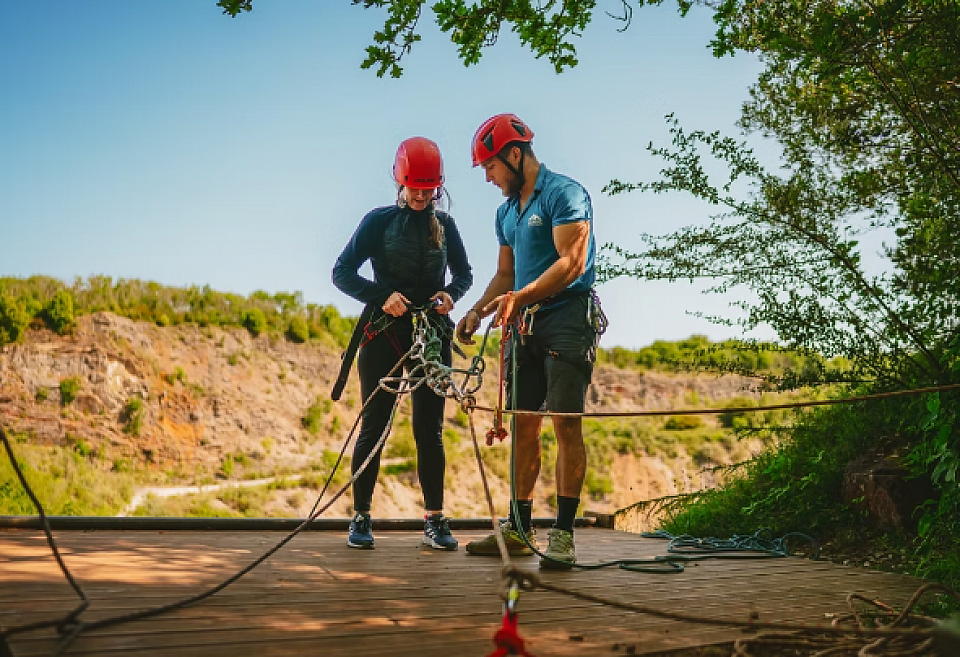
Climbing Instructor and Student
FCOA CLIMBING INSTRUCTOR course
To become an instructor, candidates must have completed all previous climbing courses and demonstrate their ability to teach and certify others. The course emphasizes risk management and the importance of ensuring students practice safely.
Prerequisite
- Your a certified FCOA improvised climber
- Your a certified FCOA TOP ROPE CLIMBER
- Your a certified FCOA LEAD CLIMBER
- Your a certified FCOA RESCUE CLIMBER
- You have completed FCOA Lesson 5: "Coach training"
- You have certified 5 FCOA Improvised climbers.
- You have completed Lesson 10 Lead coach training
Risk Management
FCOA recommends to keep climbing students practicing below 2 meter until they master all the improvised climbing concepts. That's slightly different then how other climbing organizations do it. We want our climbers to take responsibility of their own safety from day one. Before they go up, they should be fluent with all needed knots and with rappelling. If they are still making mistakes in their knots, or if they still don't appear calm and methodic when rappelling from 2-meter height, then they still have plenty to develop close to the ground. For some climbers prusiking is very tough, due to body weight or lack of strength. They don't have to master prusiking up before they start the Top rope training. But they should be able to explain how prusiking works and they should be able to demonstrate the knots involved in a repeatable fashion.
Top Rope Climbing:
Liability
Even though FCOA trains their members to look after their own safety, when something goes wrong everyone is pointing fingers at the instructor. And even when you are the best instructor, you cannot always control everything. Our members agree with liability releases on both FCOA.online and in the FCOA improvised climber quiz. But it's the responsibility of every climbing instructor to check what documents are needed for the best legal protection in their area.
Passing Criteria
- You have certified 5 FCOA Improvised Climbers
- You have trained 5 FCOA Top Rope Climbers under direct supervision of an Instructor
- You have trained 2 FCOA Lead Climbers under the direct supervision of an Instructor
- You have 10 Documented Lead climbs on video
Got Questions? We have climbing answers
Q: How dangerous is rock climbing?
A:Rock climbing carries inherent risks, but when practiced with proper equipment, training and precautions. Rock climbing is not considered extremely high-risk when safety measurs are followed.
Data shows that fatalities are rare, with the U.S. averaging roughly 15 climbing deaths per year despite millions of climbing days annually, making it safer than driving, which has a higher annual death rate (1 in 9,000 vs. 1 in 12,000 for climbing). Injury rates vary by type of climbing, with sport climbing reporting roughly 0.2–2.7 injuries per 1,000 hours, mostly minor overuse injuries to hands and fingers
Q: Do I need a certificate to go climbing
A: Most countries have no laws about who may practice climbing or who may teach it.
Q: Can I learn rock climbing by my self
A: We recommend getting trained by a good coach, this would be safer and you will learn faster. But most people in the world don't have that possibility. Many climbers have trained themselves. Most kids figure out how to climb on top of objects due to that natural curiosity. And off course that progress can continue at higher heights and on more complicated objects. When common sense is applied and common safety precautions are followed a person could learn climbing without the presence of a coach.
My first climbing gear
Owning your own equipment means you can practice skills at home. You don't have to rely on others to own the equipment you need to further yourself.
Ropes
During our Improvised Climbing Course we already encourage our students to buy their own 15 meter rope with 10 mm diameter. This can be any kind of rope that you strength test yourself and then use for home practice. But if you have the opportunity to buy a rated and certified climbing rope then your better aligned with the expectations of international climbing communities.
Harness
Even though our Improvised Climbing students get thought how to tie their own rope harnesses, for climbs of longer duration and advanced falling practice having a certified climbing harness will add to safety and comfort.
Carabiners
Steel carabiners are the easiest to find. Most hardware shops sell them. They are economic, strong, reliable and durable. But they are not certified for climbing and they are heavy. Steel carabiners are often used for top rope climbing close to home. While lightweight aluminum is usually the preference when tracking is required to get to the climb site.
Belay devices
Our improvised climbing students learn how to belay directly on the belay loop. It's good to know this option if an emergency requires it. But once you start top rope climbing all belaying get's done with a belay device. The most popular is the ATC (Air Traffic Control) since it's economic, light weight and does not twist the rope. A figure of eight or simple a steel carabiner can also get used as a belay device, but both of them twist the rope.
Climbing shoes
Greatly increase your performance, The tighter they are the better you can perform with them, but if you have to wear them for hours the tightest once are probably too tight.
Climbing Areas used by FCOA
FCOA currently offers daily climb training and climb trips in Calapan Mindoro. It's great learning ground by the sea. Some bouldering can get done along the seashore. And there are a hand full of climbing routes around the port area. From Manila you need one bus and one ferry to get to Calapan. Travel time between 5 and 8 hours.
Monthly trips get organized to Wawa Montalban this is 90 minutes travel from Cubao, Manila, if you leave around 5am before the traffic jams up the city. It's a beautiful place, there is a dam that creates an artificial waterfall. It's a place where civilization ends and nature starts. There are multiple climbing routes and some caves to explore.