Dive into Adventure: Join FCOA's Scuba Training Today!
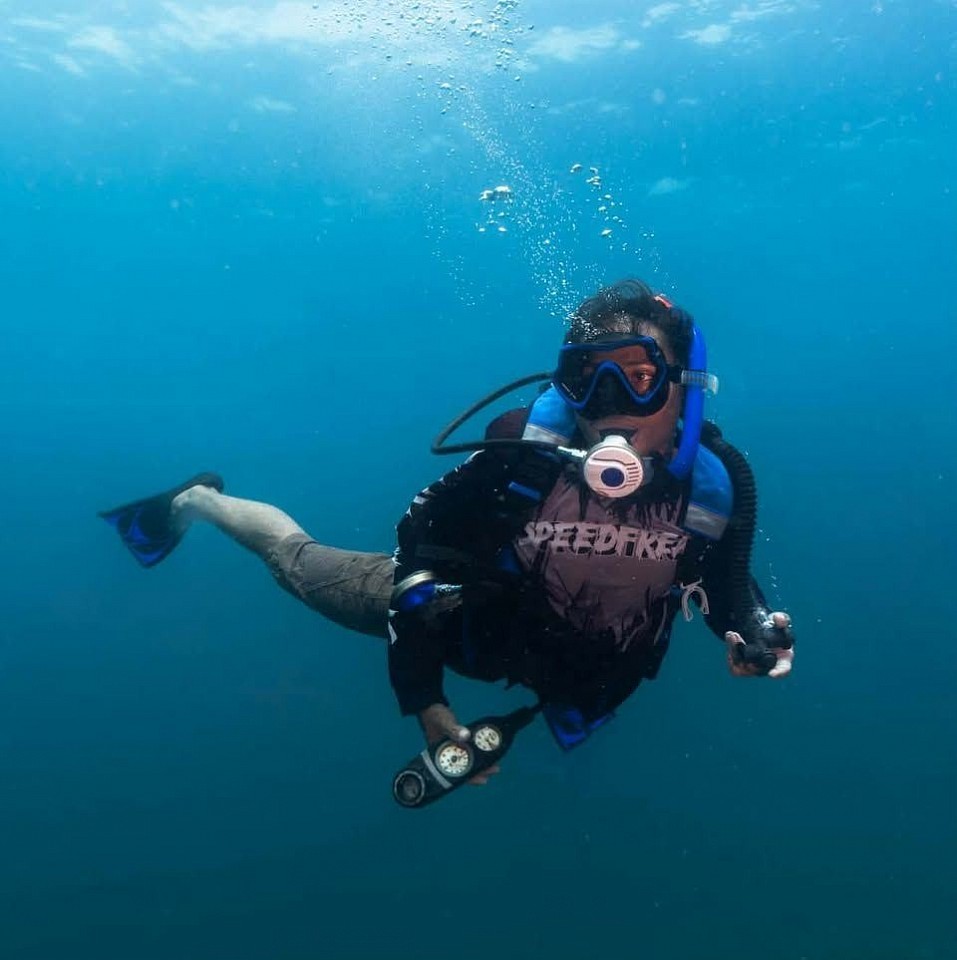
Rescue Diver John Paul exploring Mindoro
Overview of FCOA Scuba Training Programs
This webpage outlines various scuba training programs offered by FCOA, emphasizing safety, certification, and skill development for divers at different levels.
FCOA Scuba Program
The FCOA Scuba Program is designed for FCOA members and includes prerequisites such as medical declarations and prior certification in freediving. The program focuses on mastering essential scuba skills and passing theoretical and practical assessments. Successful completion allows participants to obtain CMAS certificates as well.
FCOA/ CMAS SCUBA OPEN WATER
Prerequisites: Before starting this course the FCOA member should have:
- Completed a medical declaration stating to be fit for diving.
- Completed the FCOA FREEDIVER certification or equivalent
- Mastered the FCOA MASK CHALLENGE
- Completed the FCOA SCUBA open water quiz
PASSING REQUIREMENTS:
- Mastery of the 20 chest deep scuba skills:
- Mastery of the 5 intermediate depth scuba skills
- Passing of the theory
- Four logged dives
The 20 cest deep Scuba skills:
- Mask removal and replacement
- Regulator clearing
- Regulator purge clearing
- Regulator recovery
- Regulator recovery reaching method
- Out of air procedure
- Air depletion
- Free flow inflator
- Compass Navigation straight line
- Horizontal CESA (10 sec Aaaah sound while swimming minimum 6 meter)
- Oral inflation while kicking (kick kick kick blow)
- Feathering
- Equipment donning on the surface
- Equipment donning under water
- 30 sec hover
- Forward tumble
- SMB deployment while hovering
- Buddy breathing (Optional)
- Surfacing the unconscious diver
- Free flow regulator (30 sec)
Mastery of the following five intermediate depth skills:
- Normal ascent
- CESA (Controlled Emergency Swimming Response)
- Surfacing the unconscious diver
- SMB deployment while hovering.
- Compass navigation
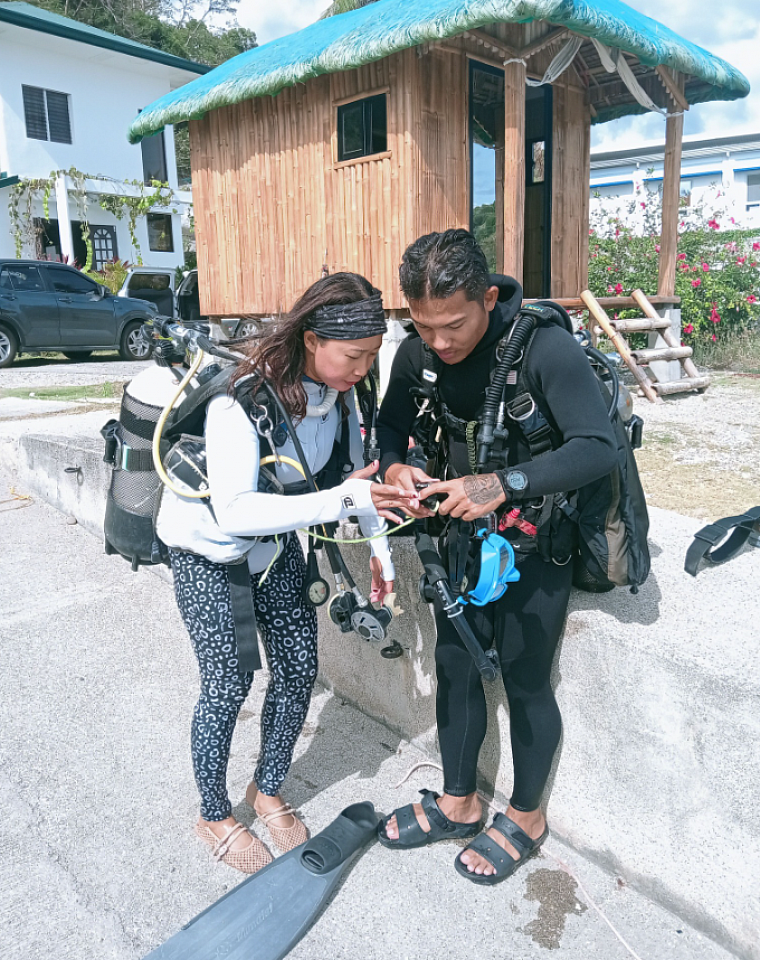
Setting the compass before diving
FCOA/CMAS ADVANCED SCUBA
This section details the advanced scuba course, which requires participants to be certified as FCOA Open Water divers. The course includes five specialized training dives aimed at enhancing skills in buoyancy, navigation, and recovery techniques. Participants must complete written briefings and quizzes before each dive.
Prerequisite:
- FCOA SCUBA certified or equivalent
- FCOA Panicked proofed
For those from other organizations, be aware that FCOA Open water divers are also certified as FCOA FREEDIVERS. Under FCOA members first get trained in freediving before proceeding to scuba, this to add to safety and boost confidence. Also, you must have undergone FCOA Panick Proofed. That is a single shallow dive where tailored pre agreed challenges are presented to improve under water problem solving.
The advanced course as we conduct it consists out of following 5 training dives in the following order:
- Peak Performance Buoyancy
- Navigation (compass navigating a square)
- Search and Recovery
- Drift dive
- A Deep dive between 18 and 25 meter
Each dive comes with a written briefing and a quiz that should get completed before the dive.
Also we recommend reading/ browsing trough the CMAS 2 star Manual
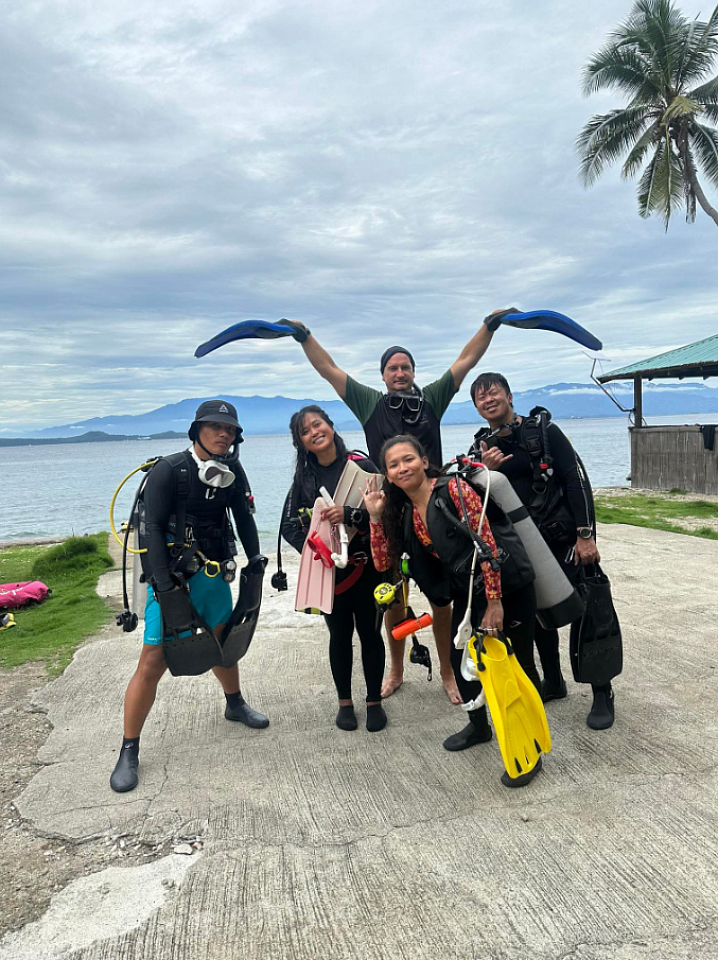
FCOA rescue training in Batangas, Philippines
FCOA SCUBA RESCUE
The Scuba Rescue course prepares divers for emergency situations and is a prerequisite for divemaster training. It requires prior certification in advanced scuba and first aid. The course focuses on rescue techniques and includes both theoretical and practical assessments.
Prerequisites:
- FCOA SCUBA ADVANCED certified or equivalent.
- FCOA Medic first aid certified or equivalent
- Completed the FCOA SCUBE RESCUE quiz
Passing requirements:
* Completing the theory
* Oxygen provider certified
* Mastery of the following skills:
- Search and recovery
- Surfacing an unconscious diver using his BCD
- Surfacing an unconscious diver using your BCD
- Surfacing an unconscious diver using the cradle technique and using his BCD
- Surfacing an unconscious diver using the cradle technique and using your BCD
- Transporting a nonbreathing unconscious diver on the surface
- Exciting an unconscious scuba diver from the water on to a dry surface
- Line Diving
- Response from land
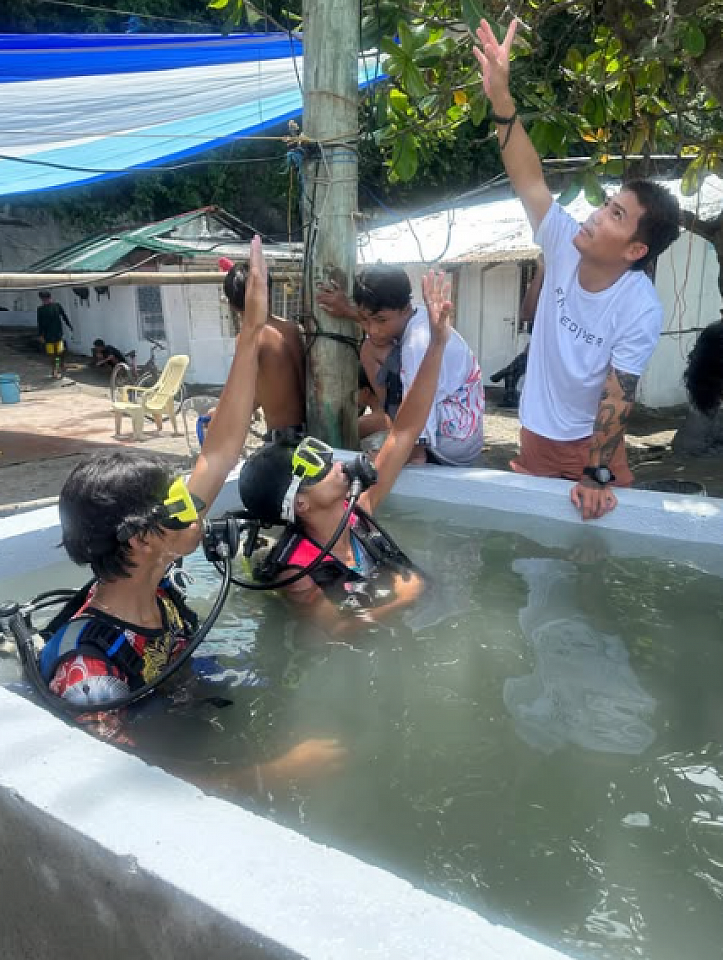
A divemaster conducting an intro to scuba
FCOA/CMAS DIVEMASTER TRAINING
Divemaster training equips individuals to assist instructors and conduct introductory scuba courses. Prerequisites include advanced rescue certification and medical clearance. Participants must demonstrate various skills, complete theory, and log a significant number of dives to qualify.
Prerequisites:
- FCOA SCUBA RESCUE certified or equivalent
- FCOA COACH certified
- > 18 years if age.
Completion requirements:
- Medical clearance.
- ID to proof your older then 18
- Open Water certification
- Advanced Certification
- Rescue Certification
- Nitrox certified
- FCOA (IWR) In Water Recompression certified
- Medic First Aid Training proof
- Oxygen Provider proof
- Completion of theory
- Demonstrated all scuba skills at demonstration level
- Repeat all the rescue skills, this time at demonstration level
- Proof of 60 logged dive
- Proof of passing the Divemaster Stamina Test (must be 15 points or more to pass)
- Must have certified 5 FCOA freedivers
- Must have certified 4 intros to scuba under direct supervision
- Participated in teaching 2 continued courses under supervision.
- Has produced a dive site map
- Has produced an emergency plan
- Passed the Divemaster Stamina Test
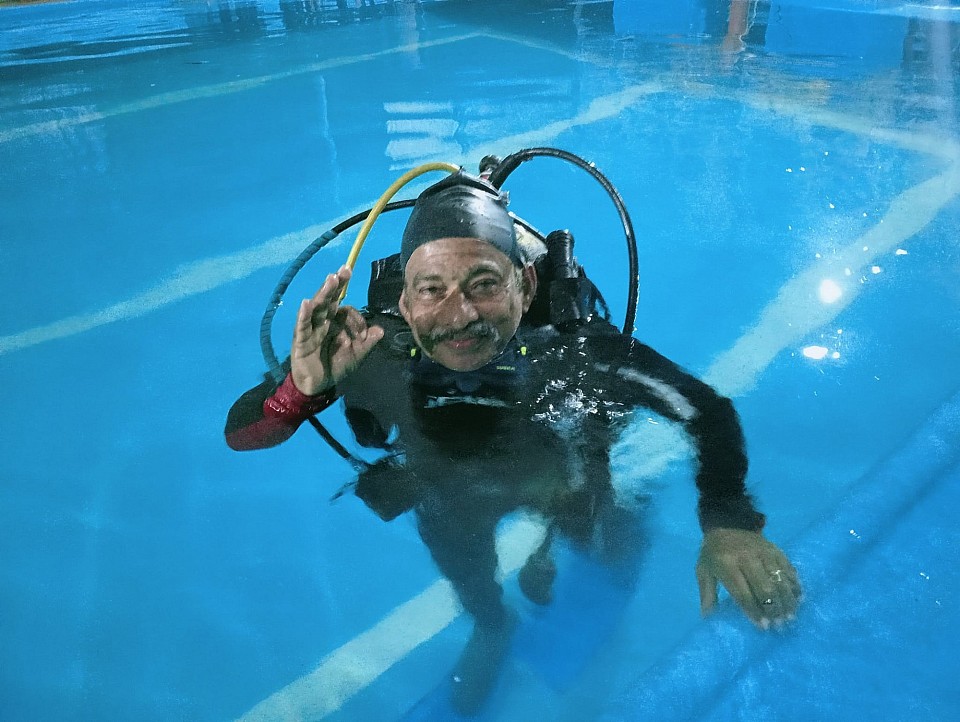
Coach James Onasseril in India
FCOA/CMAS SCUBA INSTRUCTOR COURSE
This course trains divemasters to instructor level to independently conduct open water courses and certify students. Prerequisites include divemaster certification and participation in supervised courses. Candidates must complete various training modules and demonstrate their ability to teach at an instructor level.
Prerequisites:
- FCOA DIVEMASTER certified.
Completion requirements:
- Has participated in the conduct of at least 2 open water courses under supervision. And has proven to be able to conduct an open water course independently.
- Completed the Instructor Theory
- Completed the FCOA equipment maintenance course.
- Completed the FCOA compressor operator course
- Able to discus and teach all open water scuba topics at instructor level
- 100 logged dives
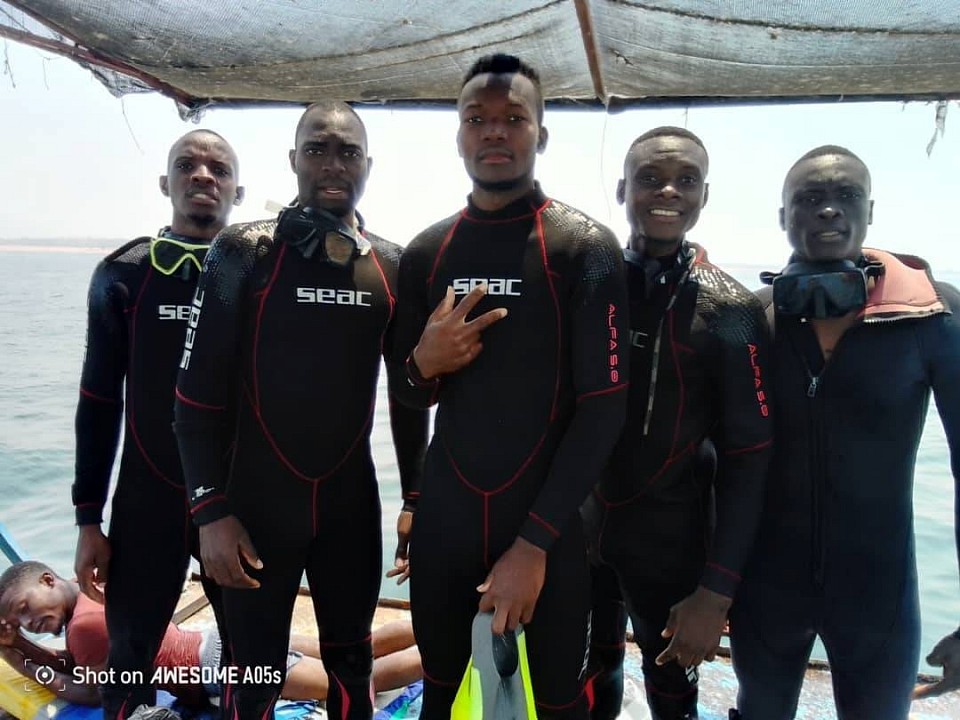
Our Dive buddies in Zambia
FCOA/CMAS SCUBA ADVANCED INSTRUCTOR
FCOA ADVANCED SCUBA INSTRUCTORS can conduct all scuba courses from Open water to Divemaster level independently.
Prerequisites:
The biggest difference between an instructor and an advanced Instructor is that you will not only give open water scuba courses, but you will also be able to conduct independent continued courses like Advanced, Rescue and Divemaster.
To become an FCOA Advanced Scuba Instructor you need to:
- FCOA Lead Coach certified
- Has certified at least one FCOA COACH
- certified at least one FCOA Nitrox diver
- certified at least one FCOA Oxygen administrator
- certified at least 5 FCOA scuba divers
- given at least one Advanced course under supervision with minimum help
- given at least one Rescue Course under supervision with minimum help
- given at least one Divemaster Course under supervision with minimum help
To become an CMAS ADVANCED INSTRUCTOR (Or M2 or 2 star Instructor) with CMAS Philippines You need to be an CMAS M1 Instructor You need to have certified a certain number of open water students. (Between 5 and 25, this requirement is not in writing and varies over time). You need to pay a certain amount between 50.000 php and 1500 php, the amount depends on various factors like: are you in a region where CMAS is not yet represented, are you also an Advanced Instructor with another agency, your patience, your negotiation skills. The licensee has no expiration date on it and is valid for life. CMAS might ask you to pay 1500php per year when you haven't certified anyone. As long as you certify 1 person per year they wave the membership fee.
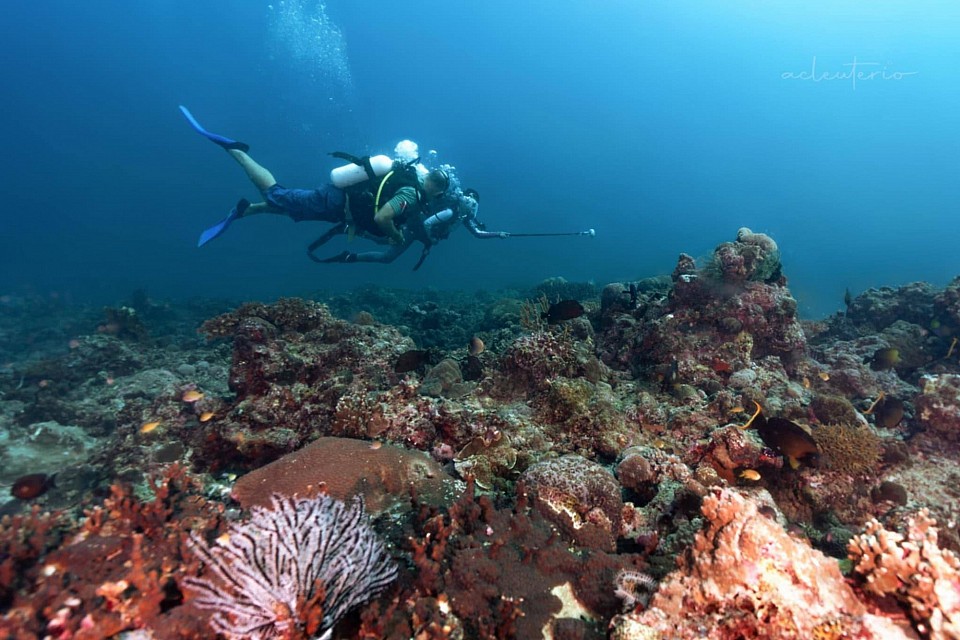
Diving in Paola, Mindoro, Philippines
Train the Next Generation of Instructors!
FCOA/CMAS INSTRUCTOR TRAINER COURSE
The final section discusses the Instructor Trainer role, which allows individuals to train and certify new instructors
Prerequisites:
- FCOA Advanced Instructor certified.
- FCOA member for at least one year
Passing requirements
- Conduct of two Scuba Instructor courses under supervision
- Certified at least 1 IWR training
- Participated in teaching an advanced Instructor course.
Real Experiences: Why Choose FCOA for Scuba Training
I did it. After a few months of diving adventure I became an instructor. I owe a lot to Jeroen Elout and Freediving Coaches Of Asia. Also for all my students who trusted me. I invite you to diving courses in Puerto Galera. I promise that you will fall in love with the underwater world and thanks to the training your dives will be safe.
After completing the course, you will receive the FCOA and CMAS certificates recognized worldwide.
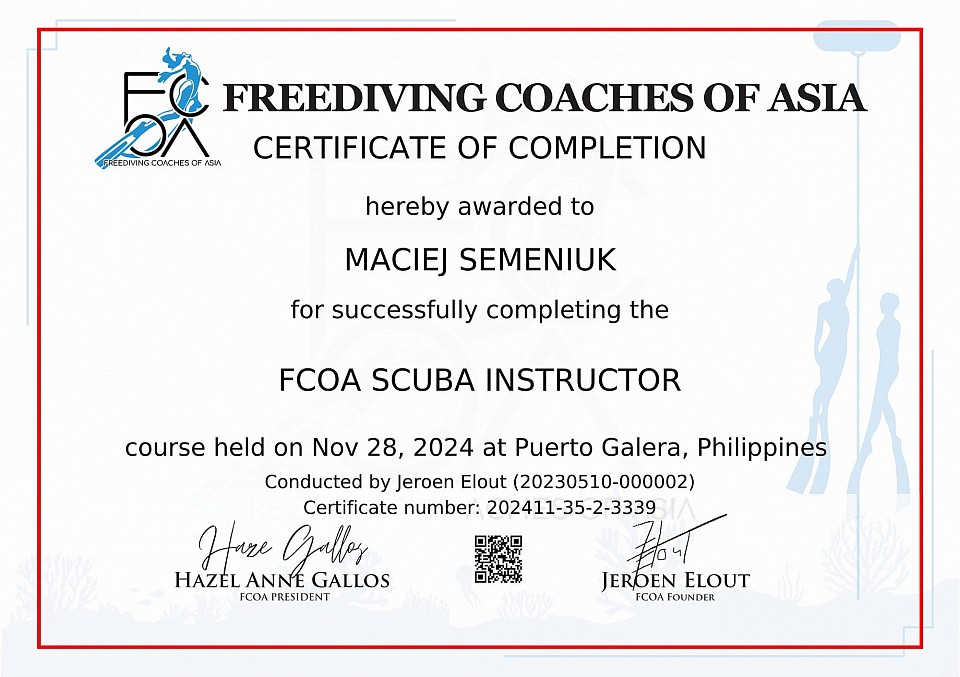
Maciej earned his Instructor rating
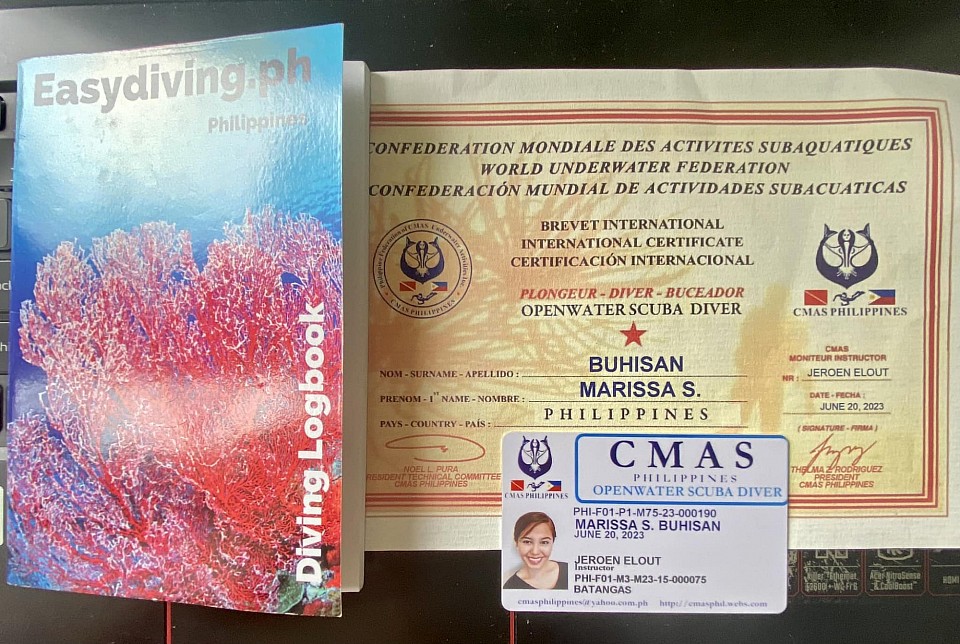
CMAS certified and ready to explore
Dive Into Success: Another Happy Diver's Story!
Skill unlocked: Longer dive time
Thank you so much Jeroen Elout for making me Ansis Ivan’s guinea pig for DSD . If not for that, I wouldn’t realize the beauty of scuba diving. Thanks to master Kexia Jamantoc Gocotano too sa pambubudol tara na, mag aadvance open water na ko Cheers to more dives — freediving and scuba diving .
Stay Safe Underwater: Essential Diving Tips!
Just some safety reminders:
- Learn freediving before scuba
- Don't fly after scuba
- Don't freedive after scuba
- Don't go up in the mountains after scuba
- When scuba diving, don't offer compressed air to freedivers that visit you
- Dive within your limits. Figure out your balance and rental equipment in shallow water before descending to a deeper depth.
- Speak up when you have concerns
Got Questions? We’ve Got Answers!
Q: I'm certified with another agency, can I continue with another one?
A: Yes, if for example you did your open water certificaton with FCOA you could continue with advanced with PADI, NAUI, CMAS or SSI
Q: Is my certificate internationally recognized?
A: Yes, yet many dive centers do a refresher dive with any of their new guests. This is also the time when local circumstances are explained and where forgotten safety procedures get refreshed.
Q: How deep can I dive?
A: Open water divers are trained to dive to 20 meter, Advanced divers up to 30 meter and for those with additional depth training 40 meter is usually considered the maximum safe diving depth for scuba divers on compressed air.
Q: How long will my tank last
A: This depends on how fast you breath and how deep you dive. Everage dives usually have a duration of 40 minutes. And you're supposed to surface with 50 bar reserve
Explore Amazing Diving Spots with FCOA!
FCOA currently teaches Scuba all year around in:
Pagkilatan Batangas Philippines
Puerto Galera, Mindoro Philippines
Calapan, Mindoro Philippines.
We also have instructors at other locations that either run training events or can get hired for tailored trainings.
Most of our Scuba Instructors live in the Philippines, there are also some FCOA scuba Instructors in India, Zambia and Uganda.
The great thing about the Philippines is that many dive sites are near land so you won't always need a boat. This reduces travel time, costs and carbon footprint.
Why Getting Certified is a Game Changer!
There are some risks to Scuba diving that you won't know about if you don't study them. When your down there you don't feel extra nitrogen flowing in your blood.
The requirement for SCUBA certification is essential for ensuring safety and responsible diving.
Certification courses teach divers how to handle essential diving equipment, master breathing techniques, and understand important safety protocols .This training helps prevent accidents underwater by preparing divers to respond calmly and effectively to emergencies such as equipment malfunctions, nitrogen narcosis, or sudden changes in dive conditions.
Certified divers gain a complete understanding of dive physics and physiology, including how pressure affects the body and the importance of proper ascent rates to avoid decompression sickness. This knowledge ensures that when diving, divers are not just having fun but doing so responsibly and with confidence. Diving without certification can significantly increase the risks, while certification lays the foundation for a safe and successful diving adventure
Also when diving at new locations they will treat you as a beginner and sell you Discover Scuba Packages over and over if you have no certification of logbook to show your experience.