Freediving Training Programs
FCOA 10 Day Dive Coach Training (Non swimmers are welcome)
Events Coming Up!
28/05/26 till 07/06/26 San Esteban, Philippines Ten day dive coach training by coach Cha and Instructor trainer LV
05/05/26 till 05/06/26 Mindoro, Philippines
I wanted to ask when would the next training in India be? Thank you
FCOA Lesson 1 - Breathing and Equalization
This lesson can get done after the 200 meter swim. As long as participants can't swim 200 meter yet, we recommend to train in chest deep water to add to safety and comfort.
Dry briefing
Optimized Breath Hold Mask & Snorkel use Equalizing Dive protocol & blackout respons Rules of Rotation (optional for bigger groups) The Duck dive
Followed by the in Water Exercises
Dive protocol & black out response Mask, snorkel and fin use (Optional) Attempt to Equalizing Attempt to duck diving Dive tour (optional sight seeing)
The students can collect the following personal best performances in time or in depth.
Static Apnea (STA) maximum breath hold while lain Free Immersion (FIM) Pulling down on a rope Constant weight (CWT) Swimming down using fins Constant weight no fins (CNF) Swimming down with no fins Variable weight (VWT) Allowing a heavy weight to pull you down Dynamic with fins (DYN) Swimming with fins horizontally Dynamic No fins (DNF) Swimming with no fins horizontally
By keeping record of your personal best performances, you can keep track of your progress
The bare minimum requirement for members to request a certificate of attendance of this lesson is that they have been introduced to all the topics in get started with freediving. It can and should all get done in shallow water if members are not yet cleared for deeper water. Repetition of skills in deeper water is optional. They don’t need to have mastered any of the skills, but they should have an understanding on how to further practice those skills in the future dives.
Water Work
THE SPIROMETER (A simple tool to measure and understand exhale volume)
As participants arrive you could do the spirometer measurement with them. It's a great ice breaker and it assures that no one is just sitting and waiting for the official class to start. The spirometer is goofy, nerdy and it makes participants giggle. At the same time it touches Archimedes and Boyls law in a very playful and visual way.
After they exhaled into the spirometer, let them push down the spirometer so they can actually feel the buoyant force.
1 Tell them they get 1kg of flotation out of every liter.
2. Tell them that an average complete exhale is ¾ of the lung volume. Ask them to calculate their lung volume.
3.Tell them that a dive to ten meter will compress their lungs to half the size, ask them how much heavier that will make them.
ARM SPAN MEASUREMENT
For participants to know how deep they are, they could count their armspans on the way up. Measuring armspans could be another time filler while participants are still arriving. If you choose to not spend time to actually measuring armspans then the average armspan for man and woman can just be stated. Most man have an armspan of around 150 cm. You could ask them how deep they were if they pulled up 4 times (It's 6 meter). Most woman have an armspan of around 133 cm. You could ask them how deep they were if they pulled up 3 times (It's 4 meter)
GETTING TO KNOW EACH OTHER ( 5 to 15 minutes)
Once the group is complete an introduction round is a good way to bond with the group. The usual questions being, What’s your name, Where you from and what is diving to you. Depending on group size and time available you could either ask more or less.
THE MISSION STATEMENT ( 1 to 2 minutes)
Introduce the FCOA program, and ask participants to read 3 missions out of their logbook, shortly elaborate on each mission.
OPTIMIZED BREATHHOLD ( 5 to 10 minutes)
You could say: “I’ll take you buy surprise, hold your breath RIGHT NOW!
The surprise breath hold is a great way to kick-start your briefing. It should be unannounced and with no explanations otherwise it would not be a surprise. Call out the 10 second marks. Once they are done, tell them they did great, no matter how short or long they did hold. Tell them “the surprise breath hold is the time you have to escape a sudden boat capsize”
Show them where to write ✍️ down their surprise breath hold in their logbooks.
Breath hold and Relaxation
1. The breath up: Make them copy your breathing: 2 full inhales and exhales, to assure having the freshest air in the lungs.
2. Relaxation: Tell them: “You have billions of cells in your body, they all need oxygen, if you slow them down they will need less oxygen. Let’s measure how relaxed we are right now by measuring our hearth rate”. Then let them lay down and relax for 2 minutes. After that measure the heart rate again. Followed by the breath up and again a breathhold.
❤ Measure the heartrates for 15 seconds and multiply it by 4. Help those that can’t find their heartrates. Make them write ✍️ it down in their logbook
Demonstrate how to relax, mention:
1. To keep the body relaxed and as flat as possible to reduce the hearts workload.
2. To keep the arms straight to have the least obstruction in the blood vessels.
3. To keep the eyes closed since the eyes also use oxygen.
4. To relax the mind with sleepy thoughts or through meditation.
During the 2 minutes relaxation don’t talk and try to keep the environment as quite as possible.
After 2 minutes with an easy voice tell them to remain relaxed but to gentle find the ❤ heart rate again. Tell them if they cannot find it that they should not worry about it, since we want them to remain calm. After the 15 second measurement tell them to remember the number and relax again.
Let them follow and copy the sounds of your breath up. Then on the count of 3 tell them to breath in as deep as possible and to hold as long as they can. Let it be quite for the first 30 seconds, then call out the 10 second marks. Tell those that finished to sit up and encourage those still holding to keep going and push for their limits.
Comments you could make between the 10 second marks are:
• Dream away, you could actually try to fall asleep
• Push for it, there is nothing unhealthy about pushing for it
• Keep your eyes closed so they don’t use oxygen
• If you feel your tummy move, that’s your diaphragm, it’s normal
• Try to take control of your diaphragm, try to keep it still
Once they all finish, help them to fill out✍️ their post relaxation heart rate and the dry breath hold.
Explain the term Dry Breath hold in comparison to a wet breath hold being easier due to the mammalian dive reflex.
Now take some time to also fill out ✍️ the Lung volume and the arm span.
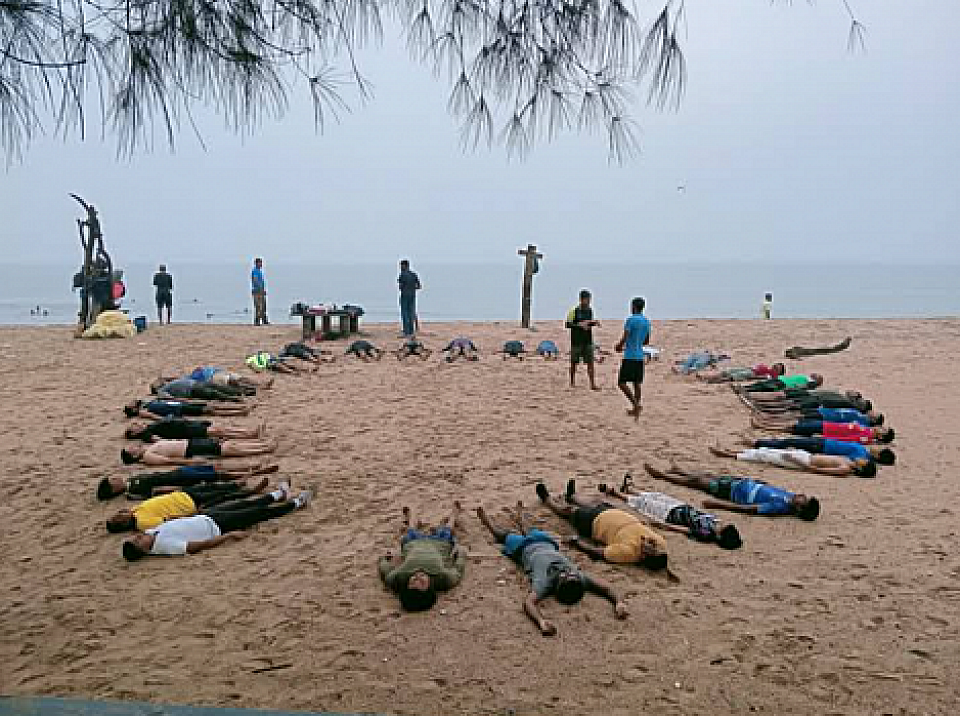
MASK FITTING, CLEARING & SNORKEL BLASTING (2 to 10 minutes)
This is an ideal topic to be presented by a coach in training. Off course they should only present it, if they are prepared for it trough a three-part roleplay. The participants should copy the demonstration (monkey see monkey do). Give participants the time they need to fix their hair and figure out how to tighten the mask. The demonstration should include:
1. The vacuum test by inhaling through the nose and listening for air leaks.
2. Strap placement above the ears and tightening/loosening the strap.
3. The hair check with 2 hands, one to pull the mask skirt forward, the other to swipe the forehead free of hair.
4. Mask clearing by exhaling through the nose.
5. Snorkel blasting: twice with a slow inhale in-between.
6. When not using the mask, keep it around the neck.
7. Different ways to defog
EQUALIZATION (2 minutes)
This is another topic that easily can get presented by a coach in training provided he gets prepared trough a three part roleplay.
Keep it simple. It’s a huge and never ending topic but right now it should get explained in less then 2 minutes. The briefing should include minimally:
• Valsalva
• Jaw movements
• Swallowing
• Bad ear up
• You should never feel pain. If you feel pain your to deep already.
DIVING PROTOCOL & BLACK OUT RESPONSE ( 1 to 3 minutes)
This should include:
1. Diver signing to the safety diver: You look at me, the safety diver confirms with an ok sign.
2. As the diver dives the safety starts counting
3. Checking if the diver is conscious trough: Tapping, Rope tugs or the use of the grouper call.
4. As the diver comes up he should attempt to recover trough the snorkel. This is a skill that takes time to learn. Ironically most freediving programs don’t teach it while scuba diving programs consider it a mandatory and valuable skill. Participants that don’t get taught how to recover trough the snorkel will miss out on proper airway development. Once the skill is mastered participants can choose to either recover trough the snorkel or with the head out of the water.
5. After the divers first breath, the diver and the safety buddy have a combined responsibility to make eye contact.
6. The safety buddy asks if the diver is ok with an OK sign. The diver replies with an OK sign. The safety buddy now counts 5 seconds on his fingers in front of the face of the diver. Then he once again asks if the diver is still ok.
7. The diver pretends to black out. The safety buddy should turn him around by the shoulders without making the common mistake of trying to get behind the unconscious diver. This should get done gently but without delay.
(At this stage we let students recover from their breath holds with their subconscious natural breathing. Some trainers teach the “recovery breath” or ‘Hook breath”. Be aware that this method doesn’t have much scientific backing. It’s a discussion and a method we will discuss in detail in lesson 6 with more advanced students. For introduction students this topic could lead to confusion, time loss and information overload)
FAKING UNANNOUNCED EMERGENCIES
Encourage participants to fake unannounced emergencies when ever they like, especially if they feel their safety buddy is not focused. Before faking emergencies make sure that you:
1. Only fake emergencies that fit in the scope of the so far covered lesson. In lesson one by example we only deal with service emergencies so don’t pretend to be blacked out under water.
2. Only fake emergencies if it will build the confidence of the safety buddy. If the safety buddy is already exhausted or stressed, then adding a fake emergency to it could potentially be traumatizing and it would reduce their confidence.
3. After the executed rescue first state everything that was done right and good and then add how it can even be better and faster and more gentle next time.
RULES OF ROTATION (Optional for groups) (10 to 15 minutes)
The rules of rotation assure that the most amount of dives can get made in the least amount of time and that with minimum talking. All participants get an equal amount of practice dives and safety duties. The participants should practice it on land first. Ideal group size 4 to 6. Make sure all participants understand that:
1. They need to personally call out their diver numbers in a clockwise direction.
2. They need to know who their safety will be. (Second last diver to the right)
3. They need to know what their GO TIME is.
4. They need to know who they will provide safety to.
5. They need to understand that after their dive and after getting checked, they need to get ready to become a safety diver them selves. They need to make eye contact with their diver so that the diver can continue his meditation without having to demand his safety buddies attention.
Do two rounds with them. The first round is to get used to the flow. For the second round add the concept of escorting and add a blackout during the 5 second check. The safety buddies should learn to focus on their divers especially when other dive buddies are conducting blackout responses. Encourage participants to fake blackouts unannounced. Especially if their safety buddies are not paying attention.
THE DUCK DIVE (2 minutes)
It’s another stand up topic where you make the participants move. As with all topics, Don’t just talk to about it, make participants move. We first practice duck dives in chest deep water by making hand stands. This briefing should include.
• Hand stand attempts in chest deep water
• Tumbling
• In deeper water, face the rope and stay near it.
• Don’t forget to equalize
• Tumble turn
• Ascend along the rope since that’s where your safety buddy is waiting for you. And it protects you against boat traffic.
• Surface next to your safety buddy
FCOA Lesson 2 - Rescue & Self-help
Rescue & Self-help consists out of 5 hands-on rescue skills.
Requirements :
- Go over the Notes of Caution in the FCOA FULL TRAINING MANUAL
- Must watch video lesson 2 and do the quiz to increase retention
This lesson should not be delayed since it adds to safety. Often this lesson gets given the day after the introduction. The lesson is designed in a way that non-swimmers can participate in chest deep water.
For best retention, first give a dry briefing to let participants practice those skills without getting distracted by waves, cold water or currents. Then repeat the 5 skills in chest deep water and for those that are ready the skills can get repeated in deep water.
If there is a time constraint, then the briefing can get directly given in chest deep water or even directly in deeper water on a buoy if the participants are confident swimmers and able to focus.
The 5 Rescue topics of lesson 2 are:
Act out:
- Cramp removal
- Panicked swimmer response
- Transporting a tired diver
- How to be a better safety buddy and
- How to exit with an unconscious diver.
The bare minimum requirement for members to request a certificate of attendance of this lesson is that they have experienced
- Panicked swimmer response
- How to be a better safety : escort, rescue, displacement technique
- Cramp removal
- Transporting a tired diver
- Exciting an unconscious diver
It can and should all get done in shallow water if members are not yet cleared for deeper water. (If they have not yet done the 200 meter swim test) Repetition of skills in deeper water is optional. They don’t need to have mastered any of the skills, but they should have an understanding on how to further practice those skills on future dives.
LEG CRAMP REMOVAL
Demonstrate this and make participants copy you. Mention that you can also remove your own cramp by pulling your fin tip.
Having a cramp should not be a reason to leave the water. After the cramp is removed just continue at a slower pace. Also mention that to prevent cramps:
1. Hydrate before the dive.
2. Stretch before the dive.
3. And take in potassium (bananas) before the dive
RESPONDING TO A PANICKED SWIMMER.
This might be the most important rescue skill and it’s a prerequisite for coaches to be able to respond calmly and methodically to a panicked swimmer in deep water.
As a coach you will sooner or later have to deal with panicking swimmers. Tell the participants that “A panicking swimmer wants to climb out of the water and will try to climb on top of anything they find including you. People have drowned trying to rescue panicking swimmers, so what to do If he gets a grip on you and locks his arm around your neck? …Blow out completely so you start sinking. The moment you start sinking he will let you go because he does not want to go down with you, he wants to climb on top of things that float! Now get behind him and once again put your palms together, place them in his neck and your fingertips towards his ears, keep his mouth above water. From this point onwards you got to get him talking. As long as you can keep him talking, he will not get back into a panic”.
You can start with: " I got you, what is your name? Can you hear me properly? Where are you from?
Shall we slowly swim to the shore?
Every sentence should be a question to demand the person to think and answer leading him away from the panic. Once he is calmer you can ask him to hold your shoulders.
In that way you can actually see where you are going and now you can also use your hands to swim. Now there are three points to address:
1. Don’t push me down ok? You would want to instruct him to not push you under. Tell him that only his mouth needs to be out of the water and not his whole body.
2. “You like to swim along and just move your legs a little”? Now the panicking swimmer has the feeling that he is part of a team effort and that makes him feel less helpless. Panicked swimmers are often embarrassed about needing help so the more they can do for themselves the better.
Once you can stand:
3. “Would you give me one minute to show you a colourful fish? Persuade the person to spend some time with you in shallow water.
Don't make a big deal out of the rescue, simply acknowledge that the area he was in was not suitable. Point out an area where he could practice safely. Then show him some fishes in that shallow area and do something enjoyable, so at least he goes home with also some happy memories.
TRANSPORTING A TIRED DIVER
Tell the participant that:
In case your buddy is tired and needs a pull, an easy way to do so is to put your arm under his and tag him along like a hand bag. Either the right arms connect, or the left arms connect, up to you. Instruct the tired diver to maintain flat, to keep his ears under water and to look at the sky. The assisting diver can now snorkel while transporting the tired diver, if you got a long way to go then keep an eye on your direction and on boat traffic. Once you approach the shallows, make sure to have your mask on and snorkel in so you can look under water and avoid obstacles like sharp corals or big rocks. Practice this for about 25 meter.
HOW TO BE A SAFETY BUDDY
Tell the participants:
In lesson 1, we did our first dives and learned how to safety each other, we did safety each other from the surface and we practiced how to get the divers mouth out of the water in case he blacks out. In this lesson the safety diver will start going down to meet the diver to ESCORT him upwards. Even if you only want to go down half a meter, that is fine, just get the feel of it.
If your diver chooses to recover trough the snorkel then it’s handy if you as his safety buddy does the same so you can keep continues eye contact.
There is actually a way to clear the snorkel that takes no power at all, it's called the DISPLACEMENT TECHNIQUE. It only works when the snorkel is upside down, which it is when you're coming up from a dive and you're looking up to the surface. Once you’re one fist away from the surface passively exhale and the snorkel clears without effort. Now swiftly bring your chin back down and your snorkel will be completely empty without needing to blast.
As a safety diver you are giving a service to the diver. There are different things the diver could request from you. Your sign to start your escort dive could be based on:
1. Vision
2. Sign based
3. Time based
4. Turn based
for example, the diver could ask you:
“Once you see me coming up start coming down for me OK?” (Vision based)
“Once you feel me pull the rope 4 times or you hear me give 4 grouper calls start coming down for me, OK?” (Sign based)
“After 1 minute has past, start coming down for me, OK?” (Time based)
“When you feel me do the tumble turn, start coming down for me OK?” (Turn Based)
The diver recall sign: 4 tugs, 4 taps, 4 grouper calls or 4 boat engine revings is a sign to the diver to come up without delay. If the diver gives this sign of 4 it’s a sign to his buddy to come down for him.
If your diver asks you to meet him at a certain depth then make sure that you are very comfortable at that depth. After all you won't have a safety buddy yourself. Per definition, safety divers are solo diving. There is also no shame is saying “I can only safety you at the surface”, or “I can only meet you at 1 meter depth”.
Later, once you’re in the water, first practice a normal dive. And ask your buddy to come down for you when he feels you pull the rope or when he sees you coming up.
If you’re the safety, remember to keep your hand on the rope, relax, no body movements, practice the rope tugs that are asking "Are you still awake" and practice the grouper calls. The diver should say how often he likes to get signalled with. If you’re the diver, make sure to come up with the line, make sure to just float up and not swim up, make eye contact with your safety so he can easily see how you're doing. surface along the rope, next to your float, away from boat traffic and near your buddy.
BRINGING UP AN UNCONSCIOUS DIVER
During the second dive the diver will pretend to pass out at an appropriately safe depth for his safety buddy, he could simple close his eyes and stop moving. Or he could pretend to suffer a loss of motor control (LMC) and start shaking. In that case grab the diver and pull him up in any possible way that brings his mouth out of the water without delay. There are some different ways that this can be done, the main thing is that there are no delays and that in minimum time the mouth is being held out of the water. The rescue should also be gentle. When a diver suffers a loss of motor control he can often still see, hear and feel things, so be gentle to not add to the stress.
Make a habit of faking emergencies regularly like on every second dive of the session or randomly when you feel your safety buddy is less focused and efficient then you like him to be. Trust has to get earned. Don’t trust your buddy because he is a nice guy, or because he is family or has certain certifications. Trust him because he has responded appropriately to a multitude of fake emergencies. By that time his emergency response has become second nature, he conducts it in an automatic fashion.
5. EXITING,
Demonstrate:
How to Exit the water with a tired or unconscious diver. Once you can walk, take your fins off, stand behind the tired diver put your arms under his arm pits and grab one of his arms and just pull him towards the beach. Once it gets to shallow you better sit down, especially if the ground is uneven and could cause you to fall. Now put his arms under your knees and lock them on top of his hips. Then place your hands on the ground behind your back. Like this you can crab your self up on to the beach. The further you get, the harder it gets, take your time, If it gets really hard, then super charge your knees, pull one knee at a time towards you with two hands, like your spring loading them and then stretch out again. Maybe you only move one centimeter at a time and that is fine as long as you just keep going.
NO MASK DIVING
During this session we will also do a few dives without mask. This to not grow dependent on it. We don’t need the mask to dive. Even though your vision will be blurry you can still see enough to move around. It’s possible that some water enters your sinuses. Try to remain calm and to tolerate it. If you have contact lenses then close your eyes at the moment of transition from air to water or water to air to not accidentally loose a lens. Once fully immersed you can open your eyes again. Eventually not having a mask should not be a factor that reduces your diving time or diving depth.
A note of caution about
HYPERVENTILATION. This is when you do more then 2 breath ups.
Tell the participants:
“Let’s see what happens in your body when you hold your breath. Hold your hands in front of you. Your right hand represents your bodies O2 level and your left hand the CO2 level. What happens if you hold your breath? O2 goes down and CO² goes up. When CO2 is high enough it triggers your brain to breath, then the CO2 reduces again and O2 comes back up.
When you hyperventilate the O2 does not really go up much higher cause your blood is already saturated by default. But your CO2 drops lower and lower. Now if you hold your breath you can hold it longer. You never feel the trigger to breath. You could deplete your O2 without warning. This is called the SHALLOW WATER BLACKOUT; people have drowned due to this in bathtubs and swimming pools so don’t take it lightly. If you want to experiment with hyperventilation, then your bed is the safest place to do so. When you bring it to the water make sure your safety buddy wants to be part of it.
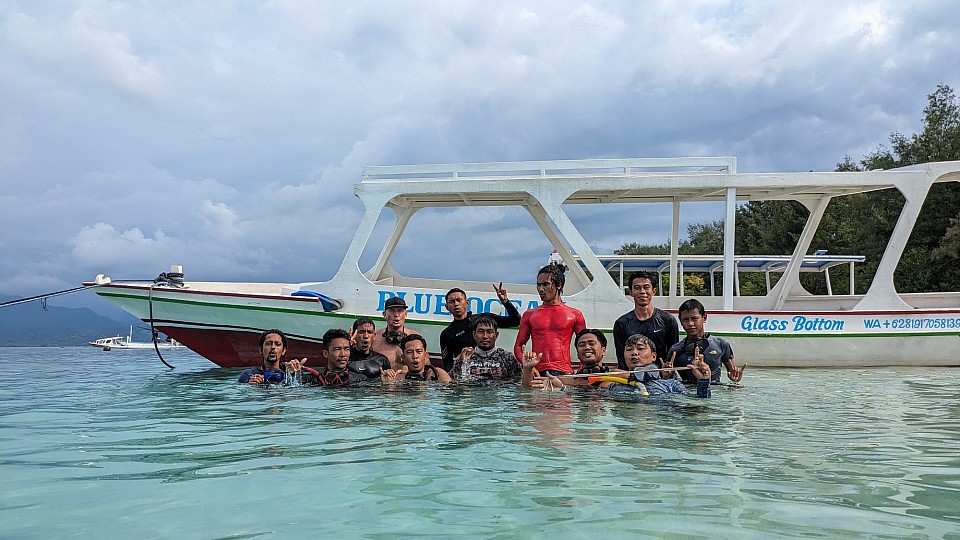
Our Diving buddies in Indonesia
Lesson 3 - Navigation
Nautical navigation is a crucial topic often ignored up to instructor level. The reason for this is that many dive operators have boats and boat captains to drop of and pick up divers so in that way most navigational aspects of the dive are the responsibility of the boat captain. But at FCOA we like to promote shore dives since they are cost effective, time efficient and they come with less carbon foot print. There for the divers and coaches have to be self reliant. They have to be able to predict currents and in the water they have to be able to notice those currents. Also they have to be able to find under water obstacles and occasionally that requires the use of a compass.
Let participants watch video lesson 3 to add to retention.
The topics of this lesson are:
1. Making a position Fix
2. Compass Navigation
3. Tidal forecasting
4. Time Management
The bare minimum requirement for members to request a certificate of attendance of this lesson are that they must have practiced:
1. How to be a better safety (Including the displacement technique, Escorting and under water blackout response.
2. Panicked Swimmer Response.
3. Transport of a tired diver
4. Cramp Removal
5. Exciting an unconscious diver.
6. Make students aware of all NOTES OF CAUTION trough quiz or trough lecture.
This lesson can and should get done in shallow water if members are not yet cleared for deeper water. Repetition of skills in deeper water is optional. They don’t need to have mastered any of the skills, but they should have an understanding on how to further practice those skills on future dives.
7. MAKING A POSITION FIX
This is a stand up hands on briefing. Best to be conducted in a spacious area with sand or grass. Let participants hide a coin in the dirt and tell them to find aligned visual references.
The best visual references are:
1. Aligne permanent structures like far away radio towers with near by electrical polls in front of them.
2. By rocking the head side to side or by side stepping it should become clear how sharp an aligning is.
3. The two reference lines ideally are under a 90 degree angle.
Common mistakes:
1. Participants are not aligning two references, or the 2 references are so near that you can’t notice a difference when side stepping.
2. When finding back the coin participants walk to where they remember hiding it. Instead of focusing on the references.
2.COMPASS USE
If you’re further at sea and you have not many visual clews, then you can also use a compass, let's say there is only a tree to work with, then shoot a bearing to that tree. For example, 040 degrees. (Compass bearing are pronounced as 3 singular numbers so 14 degrees is pronounced as Zero One Four degrees)
The other visual clew might be a rock at 135 degrees. Now that the fix has been established move away from it.
If later we want to find it back then we first get to the area where we can see the visual references. Let’s say we can see the tree at 010 degrees, we have to move to the left till it becomes 040 again. Once we find it we will move along that bearing. The second fix has to become 135 again so we will move along the 040 bearing to the tree till 135 matches my second bearing which is the rock.
Making a fix with a compass will be less accurate as when you align some nice visual references, especially if the front and back visual references are far from each other than your fix becomes very accurate.
Freedivers usually don't wear compasses, but more and more mobile phones are becoming water proof and some of the dive watches have a compass integrated.
A compass can also proof handy when you want to swim in a straight line to a target. Let's say you're standing on the beach and see a diver in trouble, then it's good to shoot a compass bearing before you go in the water. Once you’re in the water it might be very hard to see your target, especially if there are high waves.
When you use a compass to swim a straight line, don't get fixated on the compass, only 10% of the time you should be looking at the compass and the rest of the time you should be looking ahead of you and around you, scanning for boat traffic and checking for current. What you can do is look over your compass, pick a rock or peace of coral that lays along your heading and then just swim to rock before you look at the compass again.
If you want to turn back where you came from, then you got to add or deduct 180 degrees to your outbound heading. That's not so easy without calculator, but there is a trick, what also works is to add 200 degrees and minus 20 or Minus 200 degreed and add 20. Like right now my outbound heading is 135 degrees + 200 = 335 minus 20 = 315 degrees. 315 degrees is my inbound or homebound heading.
3. TIDAL FORECASTING
Questions for Participants:
1. Google the word tidal forecast plus the name of a big costal city next to you and you should find some kind of tidal chart. What signifies the red dot? It’s the present time and water hight.
2. What time is the next high?
3. What time is the next low?
4. What is the hight difference?
5. Can you show me between your hands how much that is?
6. What is the grey and white area (day & night)
If you want to dive with minimum current then usually you can do so close to high tide or low tide. During high tide you usually have a bit better visibility, since fresh and clear ocean water has moved towards the shoreline, while during low tide there is a good chance that the muddy water from rivers and mangroves passes our dive area.
After you looked up the tidal forecasting, look at the map and make some kind of theory of how you believe the water will be moving. It will just be a theory, but you got to have something to later check if your theory works for the place you're diving.
7. What direction you think the current will move and why?
Ok so now we can go for a dive and check if our theory is true. We will get in the water, swim out a bit and then to know if we have a current, we will have to make a fix.
Waves and currents are 2 different things, if you are out there and there are high waves, but you're not moving from your fix, then there is no current. While if the sea is flat calm and yet you have to swim to stay on your fix, then you do have a current.
You can’t feel a current when you're in the sea, because your part of it. Only once you hold on to a mooring line you can feel a current.
4 TIME MANAGEMENT
For many participants time management is not cultural and not a habit. Yet when it’s presented to them as a game, they are most likely to enjoy the concept.
Questions for participants:
1. Based on the tidal forecast. What’s the best time to dive?
To be there in time let’s work backwards and list all we need to do to get there and the time it takes.
2. How long does it take to tie the buoy line?
3. How long it takes to swim out there?
4. How long it takes to change?
5. How long for the ride (maximum)
6. How long for breakfast
7. How long does it take you to wake up
8. Do you use a snoozer button? How many times you press it and what is the snoozer interval?
9. Now add up all those timings to calculate the time your alarm clock should go off.
REASONS TO ABORT A DIVE
1. During lighting it’s safer to be out of the water.
2. If the weather, waves or tides make it hard to exit or enter the water.
REVIEW QUESTIONS AFTER WATCHING THE VIDEO
1. What kind of objects your best to use for a visual fix
2. How can you calculate your turn around heading?
3. For your location, what time will be the next high tide?
4. What is the difference in cm between the next hight tide and low tide?
5. What causes tides?
6. What causes waves?
7. How long it takes for the moon to go around the world (from our perspective)?
8. How come that most days have 2 high and 2 low tides?
9. What time today the current will be the least?
10. What are two benefits of diving at the top of high tide?
11. When you float in the water, can you feel a current?
12. How can you identify a current?
WATER WORK FOR LESSON 3
1. Once in the water lay still and check for current. Is it what you predicted? Remember it to write ✍️ in your logbook.
2. Make a position fix of a unique under water object.
3. Predict your time of arrival at your dive spot.
4. Look out for boat traffic. Is there any? Can it kill you?
5. Once at the dive spot, check how good your time prediction is.
6. Repeat exercises of lesson 1 and 2.
7. On your way back to shore find back your position fix.
DEBRIEFING
Fill in your logbook, note the current and draw your visual references
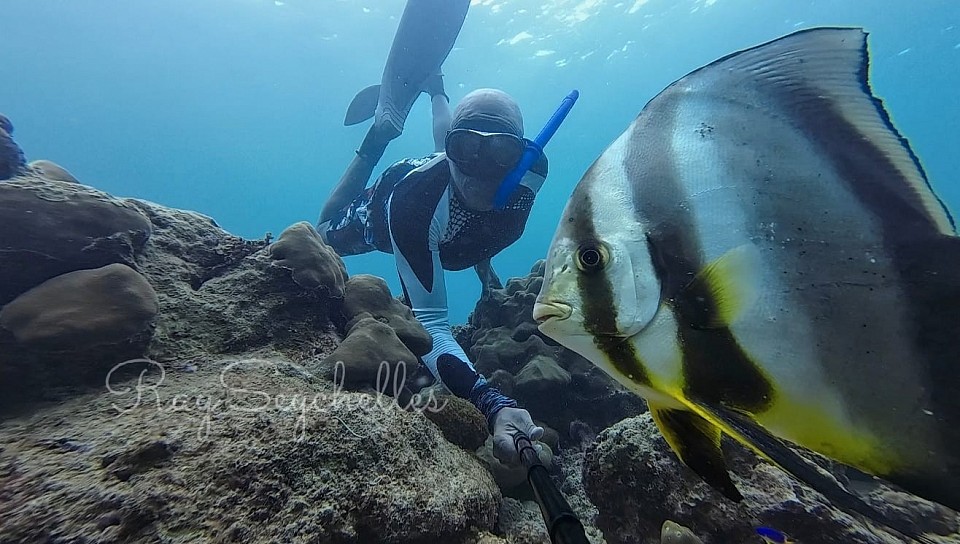
Coach Raymond and a bat fish in the Seychelles
FCOA LESSON 4 - Ropework
It takes time and repetition for participants to learn the most common knots. If time allows, they already could start practicing the most ropework in freediving, the clove hitch on lesson one with repeats in every session.
The knots freedivers use are:
1. The Clove hitch
2. The bowline
3. The double eight knot
4. The daisy chain
5. Storage
The bare minimum requirement for ropework is that the members at least must be able to tie the clove hitch on a single breath with their eyes closed in chest deep water. Some divers will never have a need for the other knots.
CLOVE HITCH
It’s a self-tightening knot and it's what we use to tie the dive line to the bottom. The clove hitch consists out of 2 hitches turned in to the same direction and placed on top of each other. Participants can practice on their feet.
After you make the first hitch recognize its turning direction. The second loop, should be an exact copy of the first one. If you want to tie on to something that it bigger than your wrist, then make the clove hitch on the rope itself. Keep the tree (the long end) straight for clarity. Then it's the same routine. Now often the rope is so long that you want to make a clove hitch in the middle of it, in that case you would make it with a double rope.
When you are going to practice this knot in the sea, first practice tying it on to something in shallow water and then slowly find yourself deeper items to tie it on. You could tie it on existing mooring lines or mooring blocks. Tying it on to the reef should be a last resort, it will damage the reef and you're likely to cut yourself, however if you knot a permanent mooring line on the reef, it will mean the boats no longer need to anchor and anchoring is way more damaging to a reef then one single mooring line being tied to it.
A good thing about this knot is that you can easily loosen it with one hand, provided there is no tension on it. If you're the diver that is still on the surface while your buddy unties, then swim the float up current so there is no tension on the rope and it will be easy for your buddy to untie it.
THE BOWLINE
This is a non-slipping knot and it's what you would want to tie around your inner tube, because you don't want a knot that slowly gets tighter and bursts the tube. It's also a knot you can tie around a person if he is about to get pulled back to a boat.
Put the rope behind you around the waist and have the loose end on the right side, the loose end we call the snake. Now on the left, on the long side, make a lake, and besides the lake, have a tree, you can recognize the tree because it has roots that go below the lake. The other side is not a tree, it has no roods.
Now the snake comes out of the lake, goes around the tree and back into the lake. And now pull the tree.
There is also a blind version in case the visibility is bad or in case you're working with thick gloves:
Put the snake in your armpit. Now punch yourself in the stomach and then punch yourself against the chin. And have a look, do you recognize the lake? Do you see the tree? To keep it easy, keep the lake nice and big. Now simple pass the snake around the tree and pull your whole hand and snake out of the lake. And pull the tree, there you are. Try it one more time with eyes open and then one time with your eyes closed.
THE DOUBLE EIGHT KNOT
This is the only knot that does not get loosened by the combined action of shock loading and water movement. It’s the most secure knot to tie long term moorings.
After making a single eight knot about 1 meter down the line feed the one meter part trough the attachment point. Then run the loose end back trough the knot. Simple backtrack towards the ropes origin like a train on a train track.
THE DAISY CHAIN
If you want to store the rope in a bag, or you simple want to shorten a rope that is to long, then you can use the daisy chain. First of all, tie a clove hitch to your foot. Now make a normal knot but pool a loop trough. Now just stick your hand trough and pull trough the next loop, and the next, and the next. If you store a rope like this in a bag then it will probably not get tangled. The moment you want to use it, pull on the ending and the chain comes apart.
STORAGE
When you no longer need the rope you will want store it in away that it's tidy and ready for action. Measure one peace of rope from your chest to your hand and let it hang out of your hand. Now grab a full arm-span and put that on the opposite side of your hand, then repeat that taking turns by collecting the rope on the outside of your hand and on the inside of your hand. At all times if you sweep your hand down the rope it should be free, there should be no loops, because loops cause accidental knots.
Do that 4 times for now, then grab the rope by the throat, look at it as if its a puppet. Identify the head and the legs. Rap the long end around the legs and then properly lock that loop. The stability of the knot will depend on how tight you lock this loop. Then make at least 2 more turns towards the head. Now stick your hand trough the head, grab the rope, pull the rope trough as a loop. Put that loop over the head and around the throat and tighten it firmly. Now if you shake the rope, it should all stay in order. Usually its easier to store the rope in water then on land because in water it has no weight, you don't have to lift it.
THE NOOZE
This knot is also called the hangman's knot, or the suicide knot. And it’s particularly useful when tying a rope on a roundish rock. Of all knots the nooze can be applied the most snug leaving the least wiggle room for the rock to come out. After tying the nooze you could choose to tie another loop under a 90-degree angle ending with a double roped clove hitch. It now should look like you rapped up the rock to be a Christmas parcel. Try to shake the rock out f the nooze as hard as you can. If it comes out then you did tie the rock tight enough, just keep trying till you master this art.
THE FREE HANGING DIVELINE
Most freedivers prefer to dive on a free hanging diveline with a bottom weight. The benefits are:
1. Less slant in the line especially when there is a current
2. The depth markings are less distorted
3. A lanyard can get used
The bottom weight could be 6 to 12 kg. Make sure the bottom weight hangs clear of the bottom to not disturb or damage the bottom composition.
TYING ON
How to safety a diver that is about to tie on:
1. Let the diver relax on the buoy for a minute or two while the group pushes the buoy to the appropriate location and holds it in position if there is a current.
2. Ideally situate the buoy slightly up current to compensate for the distance the diver will drift back during the dive.
3. The diveline ideally is lighter then water and fully deployed, untangled and laying in a straight line on the surface.
4. The diver would hold the beginning of the rope. The safety buddy will have one hand on the buoy and the other on the diveline.
5. As the diver dives, the safety buddy should feed the rope fast enough to not obstruct the diver but slow enough to keep a sense of the divers movement.
6. The safety buddy should make an effort to keep the dive line as vertical as possible. This may mean he has to continuously swim in to a current.
7. The safety diver should visualize the actions of the diver. He could pull slightly on the diveline to feel if the rope is tied to the bottom. If that is the case then hold the line and buoy firmly for the diver to pull up on it. If it feels like the line is still in the divers hand then straight away slack again to not obstruct the divers movement.
NOTES ON LESSON 4B WEIGHT USE
The bare minimum requirement for members to request a certificate of attendance for FCOA lesson 4 is that they get to experience the neutral point. For non-swimmers this can get experienced in chest deep water by doing an upthrust measurement where you give them enough ballast to start sinking.
Before participants start using weights they should gain an understanding about the relationship between water pressure and air volume. And the best way to learn about that is by making your own syringe depth meter, what you need is a 3cc syringe, a black marker, a lighter, a pen, and a peace of paper.
First discuss how pressure builds up as we go down. Then after that address how pressure increase effects air volume. Let the students fill our ✍️ their pressure & volume table in the logbook.
One bar of pressure is caused by the atmosphere, the air that we breeze is pressing down on us with a pressure of 1 bar. Now for every 10 meter we go down we get an extra one bar of water pressure so at 10 meters you have 1 bar of water pressure plus the one bar of air pressure above the water is a total of 2 bar. Ask: “How about 20 meter? And how about 50 meter?”
Then discuss what happens to a 1 liter baloon that we take on a dive. It will be 1 liter at the surface and as you take it down it will become smaller, but how big will it exactly be at for example, 10 meter? To calculate this you simple have to DEVIDE THE ORIGENAL VOLUME BY THE PRESSURE.
At 10 meter 1/2
At 20 meter 1/3
At 50 meter 1/6
Tell the students to draw the baloon sizes behind each depth.
Now they are ready to make their own depth meters. Ask then how big their syringe is? Tell then to put the plunger on 3 ml. Then get them to seal the syringe tip with a lighter, it needs to get melted for about 4 seconds so no air can go in or out. And then 3 ml will be the starting point, tell them to write 0M next to 3ml: Zero Meter
Then ask: when you bring this syringe to 10 meter, what will happen to the volume? Remember? You will have to devide the original volume of 3ml by the Pressure of 2 bar. The plunger will stop at 1.5ml. Write next to 1.5 ml: 10M
How about 20 meters? 3 devided by 3, thats 1ml. Write 20 M there.
And 50 meter? 3/6 = 0.5ml.
Get them to complete the depth scale ask them what the pressure at 5 meter is. The pressure at zero meter is 1 and at 10 meter is 2 so at 5 meter It's 1.5 bar.
Let them use a calculator or just provide the answer. 3: 1.5 = 2ml write 5M to the 2 ml mark.
And what is the pressure at 2 meter? It's 1.2 3/ 1.2 = 2.5
They have now completed the depth gauge scale.
Now melt the syringe tip for 4 seconds to seal it. Don't be to eager to press the plunger, because the melted plastic needs to harden first. Tie a loop on the plunger so you can loop it around the dive line ready for use.
Don't tie it around your wrist cause that would create an entanglement hazard.
THE SYRINGE AS YOUR MIDDLE EAR
Lecture the student(s) “Imagine that the syringe is your middle ear and the plunger is the ear drum. You don’t want the ear drum to move because it hurts.
How much air you need to equalize in to the middle ear when diving to 10 meter?
On the syringe you can see that in the first 10 meter you loose half the volume, you loose 1.5 ml of volume of your 3 ml syringe. So you need to equalize 1.5 ml in to the middle ear.
How about when you decent further from 10 to 20 meter? How much extra air you need to equalize in to the middle ear? It's only 0.5 ml.
For that reason, in the first 10 meter of your dive you need frequent equalization. Once you go deeper the need to equalize becomes less frequent.
Also your lungs reduce to half their size when you dive to 10 meter and the amount of liters you loose are equal to the amount of kilograms bodyweight you gain. If you loose 2 liter at 10 meter you become 2kg heavier. As you continue to 20 meter you will continue getting heavier but from 10 to 20 meter it would only add 0.7 kg.
Let a student read out the definition of the Neutral point.
On the surface you are floating but as you go down you get heavier until at a certain depth you no longer sink or float and that is your neutral point, that is when you can let go of the rope and you would not sink or float, you would just stay there. Now for some divers this neutral point could be at a deep depth like 20 meter.
Ask a student to read the 3 questions in the logbook.
By wearing 2lbs weight we will bring your neutral point closer to the surface to for example 10 meters.
That would mean you only have to swim or pull till 10 meter, after that you can start gliding. Gliding is like falling down while holding your body in a streamlined position. Now on the way up you will have to work, swimming or pulling but only until your neutral point. Above your neutral point you can simple glide and slowly float up to the surface.
WATERWORK
1. Tie a Clove Hitch at the surface
2. Dive down and tie the clove hitch at depth
3. On your next dive you will wear a 2lbs weight belt. It should be easy to release in case of an emergency. When you handle the weight belt always hold it by the strap end so that the weights can't accidentally slip off. When you dive down be aware that now your likely to descend faster and need to equalize faster. Try to find your neutral point then pull up counting your arm spans to estimate your neutral point depth with 2 lbs. Remember this for your logbook ✍️
4. Then dive again and once you pass the neutral point try to glide a few meters down. Your way up will take more effort as before. Again once above the neutral point, try to glide up being motionless.
5. Repeat exercises from the last lessons especially black out responses. Try to break your personal best duration and your personal best depth.
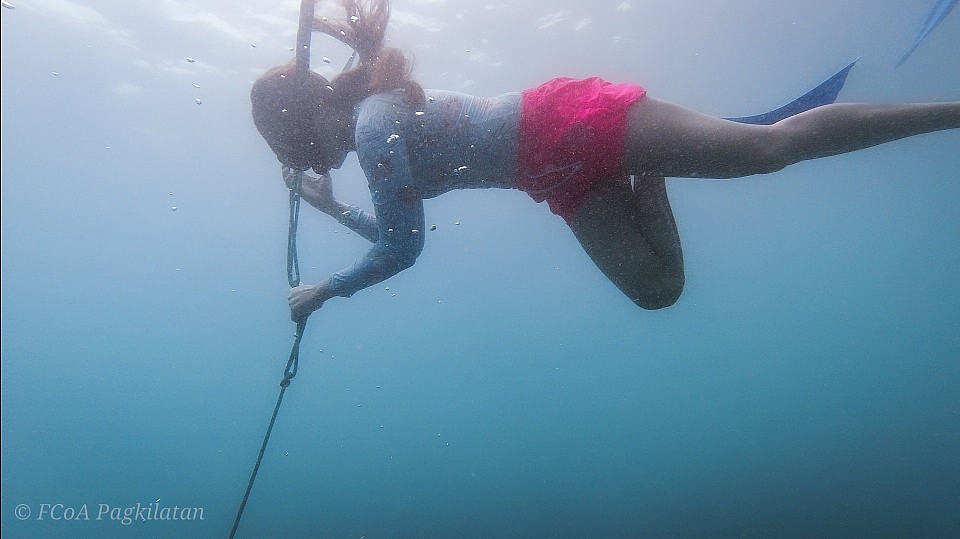
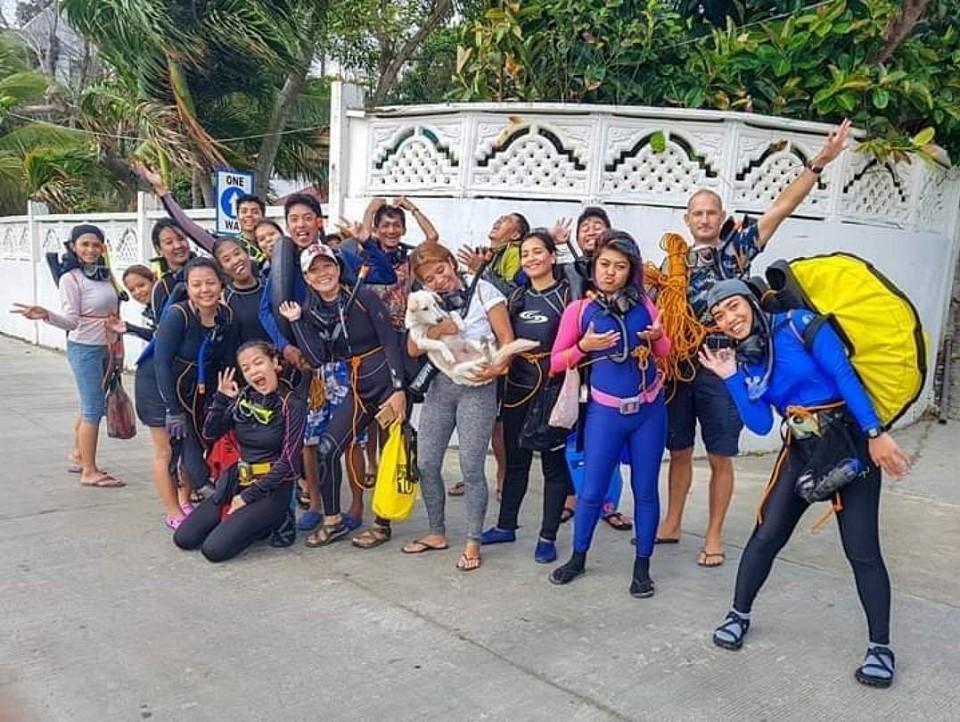
Sponsored members from the 10 day program Feb 2019
FCOA 10 Day Dive Coach Training (Non swimmers are welcome)
This Vipassana inspired 10 day dive coach program is a big commitment taking you out of your daily lives. It requires you to self study and complete homework before you register. This all to prepare you to become an effective trainer for non-swimmers and beginning divers.
Many of our successful coaches entered our program as a non-swimmer and now run independent freediving courses world wide.
Occasionally the event includes a place to sleep and vegan meals.
Thanks to the donations of participants of the past and the time and energy of our volunteering coaches, there is NO CHARGE for this 10 day course, but we would accept donations from you in the form of time, energy, food or money.
FCOA EVENT CONTRACT FOR SPONSORED PARTICIPANTS
To join the 10 day training you have to register on fcoa.online and complete video quize 1 till 5 B. You will also have to agree with the following.
I hereby commit my self to follow the itinerary of this event from start to end participating in all the activities and rules. I also commit to participate in teaching non-swimmers: survival at sea and diving, throughout my life. I will also be an ambassador for the ocean and speak up to encourage mindful interaction with the ocean and its creatures.
I understand that during the duration of this event I CAN NOT: Smoke, drink alcohol or eat animal unfriendly products (no meat, eggs, or milk products).
I understand that I should not venture in to water to deep to stand up in before I have passed the: 'FCOA Survival float challenge" and the 200- meter no equipment swim in shallow water.
I understand that I am solely responsible for my own safety and should rely on my own skills and not on the rescue or towing skills of my buddies or coaches.
I understand that I should not encourage fellow participants to venture into deeper water before they have the right skills in place.
I understand that the course starts every day at first light and ends after sunset when all my gears are prepared for the next day and that my surroundings and belongings are organized and clean.
I understand that after 21:30 I have to turn off my phone to assure proper rest.
I understand that with depth trainings we wil serve the deepest divers, we will carry the ropes and weights and set up the dive station while the deepest divers relax their hearts and minds. After the depth training the deepest divers have to make up in effort.
I understand that I have to respect time and not be late. I understand that if I'm late for anything that on the following day I need to wake up at 04:45 to join the 05:00 beach cleanup.
I understand that at some events the vegan meals are free of charge but that we will take turns cooking and preparing them and that I will participate in shopping, foraging and gardening to benefit the group.
I understand I have to follow instructions of coaches and that in case of disagreements solutions have to get found after the day's lesson in private between me and the lead coach and not in public during the teachings unless I believe safety to be at stake.
I understand that every FCOA group needs a lead coach and if its not clear who that is he/she should get choosen. I understand I should inform the leadcoach if I want to leave the group and follow his directions in how to do so.
I understand that I start participating in teaching already after the first day, but that I will only do so within my confidence and comfort zone after particular segment briefings and role play and under direct feedback of a LeadcCoach.
I understand that on the last day we first clean up and prepare our living space whether it's a boat, coach house or campsite to look good and clean for new arrivals before doing our last dive.
I understand that if we use boats we have to obey captains orders, and an additional hour per day might be needed to do maintenance and (haul) cleaning as per captains directions.
I understand I have to segregate my trash and use minimum plastic and I agree I should motivate others to do the same.
I understand I have to bring my own equipment.
I understand FCOA encourages me to bring my own gear to the event: Mask, fins, snorkel a 10 meter dive line (minimal 4mm) and a 2 arm spans fin rope (+/- 3 meter, minimal 4mm)
I understand I have to leave an ID with FCOA when ever I borrow gear.
I understand that travel costs are not included but minimal and optional.
----------------
------------------
THINGS TO BRING:
- 1. Mask, J type Snorkel and closed heel Fins
- Pen and paper
- Long sleaves if you easily burn or are sensitive to jelly fish stings
- An at least 10 meter long diveline, thickness between 4 and 10 mm
- A 2 armspans (or 3 meter) long fin-rope to tie the fins on your back. Ideally 8mm thick
- Wet weather camping gear
- Plate, cutlery and water tumbler
- Medic first aid bag with the most common medicine you might need
- (optional) a dive light for night diving. (You may choose to do it in the dark)
This is an EXAMPLE ITINERARY
DAY ZERO:
On some events, the day before the official start you may already come stay at our place, this is handy when you come from far or if you like to help us prepare for the 10 days that follow. Joining us one day before usually leads to some extra teaching opportunities.
- 05:30 Shopping Run
- 07:00 Stretching / Coach development on Apnea runs
- 08:00 breakfast
- 09:00 Dive "Coach development on divesite fixes"
- 11:30 Coach development on KNOTS (Lesson 4)
- 13:00 Lunch
- 14:00 Coach development on Physics of Exhale dives
- 15:30 Cooking or DIVE: coach/student roleplay
- 18:00 Dinner
- 19:00 Equipment prep for tomorrow
- 21:00 Lights out
DAY 1:
- 09:00 Latest arrival, personal introduction and local tour.
- 10:15 Lesson 5: Coach training11:15 Coach development and
- preparation to teach a topic of FCOA lesson 1 "The Introduction to freediving"
- 13:00 Lunch
- 14:00 Lesson 1: Introduction to freediving
- 17:00 Coach development, preparation to teach Lesson 2: Rescue and selfhelp
- 18:00 Dinner
- 19:00 Dishes and Equipment prep for tomorrow
- 21:00 Lights out
DAY 2:
- 05:30 Mandatory swim
- 06:30 Debriefing of the past day followed by: Meditation
- 07:00 Stretching / Guest Coach workout
- 07:30 Three Apnea walks and the daily 10 min run
- 08:00 breakfast
- 09:00 Lesson 2 Rescue and Selfhelp (Briefing & Dive)
- 13:00 Lunch
- 14:00 Coach development, preperation to Participation in the Lesson 3 Navigatio Briefing
- 15:30 Fun Dive, Optional for those that don't have to cook.
- 18:00 Dinner
- 19:00 Dishes and Equipment prep for tomorrow
- 21:00 Lights out
DAY 3
- 05:30 Mandatory swim
- 06:30 Debriefing of the past day followed by: CO2 tolerance training, the Wonka Method
- 07:00 Stretching / Advertising Freediving &Guest Coach workout
- 07:30 Three Apnea walks and the daily 10 min run
- 08:00 Second breakfast
- 09:00 Lesson 3 Navigation (Briefing and Dive)
- 13:00 Lunch
- 14:00 Coach Development, preparations to teach lesson 4, Ropework & weight use
- 16:00 Briefing for the night dive
- 18:00 Dinner
- 19:00 Dishes and Equipment prep for tomorrow
- 20:00 Night dive (Mandatory)
- 21:00 Lights out
DAY 4
- 05:30 Mandatory swim
- 06:00 First Breakfast
- 06:30 Debriefing of the past day followed by:the Buteyko merhode
- 07:00 Stretching / Guest Coach workout
- 07:30 Three Apnea walks and the daily 10 min run
- 08:00 Breakfast
- 09:00 Lesson 4 (briefing and dive)
- 13:00 Lunch
- 14:00 Coach development: Preperation to teach lesson 5A and 5B coach training and Medic first aid
- 18:00 Dinner
- 19:00 Dishes and Equipment prep for tomorrow
- 21:00 Lights out
DAY 5
- 05:30 wake up with your own alarm
- 06:30 Debriefing of the past day followed by: The Wim Hof Methode
- 07:00 Guest Coach workout
- 07:30 Three Apnea walks and the daily 10 min run
- 08:00 Breakfast
- 09:00 Lesson 5: Coach training and Medic first aid
- 13:00 Lunch
- 14:00 Coach development: Preparations to teach lesson 6 "The depth preparation dives"
- 18:00 Dinner
- 19:00 Dishes and Equipment prep for tomorrow
- 21:00 Lights out
DAY 6
- 05:30 Mandatory swim
- 06:30 Debriefing of the past day followed by: Meditation
- 07:00 Guest Coach workout
- 07:30 Three Apnea walks and the daily 10 min run
- 08:00 Breakfast
- 09:00 Lesson 6: Briefing and Dive
- 13:00 Lunch
- 14:00 Coach Development: Preparation to teach FCOA lesson 7 "Chest Deep Exhale Dives"
- 18:00 Dinner
- 19:00 Dishes and Equipment prep for tomorrow
- 21:00 Lights out
DAY 7
- 05:30 wake up with your own alarm
- 06:30 Debriefing of the past day followed by: Meditation
- 07:00 Lesson 7 Briefing "Exhale dives"
- 07:30 Three Apnea walksand the daily 10 min run
- 07:45 Dive: 8 Exhale dives
- 08:15 Breakfast
- 09:15 Training dive
- 14:00 Lunch
- 15:00 Coach training role play to prepare for teaching outreach
- 16:00 Promotion of our mission. Leaving reviews, defining your edge and your target market.
- 17:00 Meditation Related to Freediving
- 18:00 Dinner
- 19:00 Dishes and Equipment prep for tomorrow
- 21:00 Lights out
DAY 8
- 05:30 Mandatory swim
- 06:30 Apnea walks and 10 min run
- 07:30 Breakfast
- 09:00 Lesson 8, lost at sea
- 14:00 Coach Training Role play for Lesson 4 Ropework & Weightuse
- 15:00 Briefing on: How to train Coaches
- 16:00 Briefing on: How to plan events
- 17:00 Equipment maintenance
- 18:00 Dinner
- 19:00 Dishes and Equipment prep for tomorrow
- 21:00 Lights out
DAY 9
- 05:30 Mandatory swim
- 06:30 Apnea walks and 10 min run
- 07:30 Breakfast
- 08:30 Arrival of your Intro students
- 09:00 Intro to freediving for your friends
- 13:00 Lunch
- 14:30 Coach development
- 15:30 Fun dive (Optional) for those not cooking.17:00 Return all equipment
- 18:00 Dinner
- 19:00 Dishes and Equipment prep for tomorrow
- 21:00 Lights out
DAY 10
- 05:30 No equipment tie on dive
- 06:30 Apnea walks, 10 min run
- 08:30 Breakfast
- 09:00 Repeat of the no equipment tie on dive w
- 11:00 Ending sequence, gratitude round and goodbyea
- 12:00 program ends
BULLET POINTS FOR OUR PROGRAM
Day 1: INTRO TO FREEDIVING COVERS:
- 20 min briefing
- 2 minutes of meditation
- Measuring pulse, armspan, breathhold time and respiratory volumeSurvival floating
- Mask/snorkel/fin use
- Equalizing of the ears
- Down the rope
- Duckdiving
- and Logbook use
Day 2: RESCUE FOR FREEDIVERS COVERS:
How to be a safety
Transport of a victim.
Exiting a victim
Legcramp removal
Dealing with a panicking swimmer
Intro to freediving can get done on any event day
Day 3: NAVIGATION FOR FREEDIVERS COVERS:
briefing:
-reading tide charts
-recognition of currents
-time management
-how to make a fix
-compass use
Practice:
-predict jump in time
-creating a fix
-recognition of currents
-applying a drift correction (optional)
-drift dive (optional)
-compass use (optional)
Day 4: WEIGHT USE & ROPE WORK COVERS:
Briefing:
-knot practice, bowline, clovehitch, daisy chain and storage.
-A lecture on weight use.
-Make your own syringe depth meter
-Compression of the lungs
Practice
-weightbelt donning with 2lbs
-weightbelt removal
-Setting up a dive line
-identifying the neutral point
-Gliding
Day 5 Coach Training & Medic First Aid
- Roleplay
- Monkey see monkey do
- Group pressure
- Dealing with Traumas
- The full glass of wine
1. Response to choking
2. Managing bleedings
3. CPR
4. Managing Fractures
5. Aquatic Injuries
Day 6 Depth prep dive:
1. Rescue from depth & mouth to mouth
2. The FCOA mask drill: https://m.facebook.com/story.php?story_fbid=764556940571336&id=288542931506075
3. No fins
4. Duration
5. Depth
6. Bubble catch vision
7. Pulling up the diver (lanyard use)
Day 7 Blow out dives:
1. Residual Volume (RV) breathhold
2. The blood shift story
3. Safety on blow out dives
4. Four sensations
5. How to measure RV
6. Eight blowout dives in shallow water
7. Optional to measure RV
Day 8: Lost at sea:
1. Coordinates
2. Radio use
3. Natural Navigation
4. Collision avoidance
5. Rough water exit
Day 9: Equalizing at depth
1. Meeting our friend the equalizing challenge
2. Reverse packing
Day 10 Leadcoach training:
1. How to advertise your event.
2. The payment Setup
3. Communication
4. The Event handling
5. Duties of a lead coach
6. Creating teaching opportunities
7. The after care
8. Your credibility
9. Plan B
10. And what to do when things go wrong.
******FREEDIVING COACHES OF ASIA**********
Diving is for Everybody
Last updated January 29 -2026
FCOA FULL TRAINING MANUAL 2026
THE FCOA MISSION
80% of the world population cannot swim. That's six billion non-swimmers and 300,000 drownings per year. Besides that, we are killing our planet. Diving is our tool to make people care more about our planet and oceans. We teach people from all walks of life to swim, dive and sail and turn them into advocates for our environment.
Freediving Coaches of Asia (FCOA) was founded in 2016 by Jeroen Elout a Dutch National
Freediving Coaches Of Asia (FCOA) is a non-profit certification agency for freediving, scuba, sailing and climbing. We collaborate with divers and sailors that like to participate in our mission.
Collaborators participate in teaching and in exchange they get to do their continued courses. Scuba licenses can be converted to CMAS
Prerequisite to become a collaborator: Register in full on http://FCOA.online and complete Video Quiz 1 till 5b, contact +639174489590 on WhatsApp for feedback and guidance.
We operate mostly in the Philippines, India, Uganda and Zambia. For those that are far from us: trough Remote Verification Training (RVT), swim & dive training is available for anyone in the world with an internet connection at zero cost.
OUR 3 MISSIONS ARE:
1. To teach ABSOLUTELY EVERYBODY how to survive at sea.
2. To teach freediving because those that get to love the ocean will take care of it.
3. To train coaches so that when they go home, they will also teach their family and friends how to survive and dive.
We welcome non-swimmers and always start their sessions in shallow water.
OUR VISIONS
• To give our 20% swimming population the tools to teach swimming to the 80% that still has to learn it.
• To practice respect for life. Respect for other humans, for animals, for nature in general and for our own mind and health.
• To recognize our destructive habits and replace them with progressive once.
What differentiates us from other organizations is that from day one we encourage a coaching mindset. Our motto is “What you learn today be ready to teach it tomorrow” This allows our students to be exposed to teaching opportunities and to learn from each other under the guidance of a coach. Eventually they will become FCOA coaches themselves.
Since 2016, we have functioned as a stepping stone into the diving industry. Here a list of cool diving groups that had their initial trainings with FCOA for many of them teaching freediving has become their livelihood.
currently, we have coaches and divers operating worldwide at locations in India, Uganda, Zambia, and in the Seychelles. In the Philippines, we have coaches in Mabini Batangas, Pagkilatan Batangas, Puerto Galera, Bicol, Iloilo, Zambales, Cebu and Ilocos and Pangasinan
Our organization advocates for marine conservation and protection. We host clean-up and holiday dives to fulfil our vision of living in a world with a clean and healthy ocean and conserving our home planet.
FCOA follows the International Standard ISO 24803 for Recreational diving services
FCOA-PH (Freediving Coaches of Asia Philippines Incorporated) is registered with the Securities and Exchange Commission (SEC) of the Philippines as a Non-Profit organization since June 9, 2023 and currently being lead by President Haze Galos
FCOA-INDIA (Asian Freediving Pioneers Association) is registered with the Ministry of Corporate Affairs in India since October 17, 2024, and currently has 2 directors: President Dhvinay Vinod and Secretary Ramkumar Rajesh
FCOA-ZAMBIA (Registration in Progress by Esther Piri and Maysen Likonge)
Aqua line / FCOA UGANDA (Registration in Progress by Sanusu Businge)
FCOA-INERNATIONAL (Registration in the USA in progress by Jeroen Elout and Jacob Jose)
If you notice errors, spelling mistakes, or discrepancies in this manual, please send a screen shot of it to WhatsApp +639174489590 or to https://www.facebook.com/jeroen.elout
FCOA FULL TRAINING MANUAL
This manual works together with the FCOA video quizzes and training videos available on fcoa.online (under digital training), and the FCOA DIVELOG
This guide contains
1. The FCOA mission & vission
2. Definitions
3. Organizational structure
4. Notes of caution
5. Minors and diving with kids
6. Our 10 lessons
7. Our 10-day sponsored freediving coach program
8. Notes for coaches on the 10 lessons
9. Conversion Table between FCOA and AIDA
10. Freedivers Code of Conduct (by Haze Galos)
11. FCOA Enviromental Diver Program / Installing mooring ropes to reduce anchor damage
12. FCOA/CMAS SCUBA program
13. FCOA DIVE & SAIL PROGRAM/ Freediving from boats
14. FCOA CLIMBER program
15. Reducing Anchor Damage (Jeroen Elout)
16. About Spearfishing (An interview with Spearo: Ian Lester E. Servillon)
17. About riding turtles (Jeroen Elout)
18. About solo diving
19. Cold water tolerance training
20. FCOA National Records and Video Verification
21. Freediving Disciplines
This FCOA training manual outlines a unique training program to train from non-swimmer to Instructor trainer for freediving, scuba, sailing and climbing.
“Copyright @ Jeroen Elout 2023
FCOA DEFINITIONS
Bare minimum requirements: (In purple) This are the minimum requirements needed for a member to reach a certain level. Coaches are encouraged to first make sure bare minimums requirements are met, before isolating certain skills for further development and before the touring part of a dive. If the bare minimum requirements are not met, then the relevant certificate cannot yet get approved. Here you can find them listed. the most up to date bear minimun requirements can be found on the bottom of the relevant quiz lesson on digital training
Competent safety diver: A safety diver who has appropriately responded to at least 3 of your unannounced simulated blackouts in the last year. Trust has to get earned, you have to form a bond between you and your safety diver. We do so by faking unannounced blackouts. To consider someone as your competent safety diver you must personally experience that they respond appropriately. The fact that a diver says to be experienced or certified does not automatically mean they are competent: We don’t know the quality of their training and their recency.
Deep water: Water deeper than chest level
Deep water skill requirements of FCOA: The ability to swim 200 meters without equipment, without interruption and without standing up. And the ability to remove and replace any equipment like mask fins and snorkel while in the survival float with minimum movements in a repeatable fashion.
Down Current: the area where the current pushes you, away from your intended dive spot, this is considered a higher risk zone because if you cramp out the current will push you away from your intended dive location.
Drift correction: an angular correction made into the direction of the current to avoid drifting off course.
Gap: The difference between what we say and what we do
Grouper call: A throat sound used for communication underwater without expelling air
Non-Swimmer: A person that has not yet met the FCOA Deep Water Skill requirements
Shallow water: water not deeper than chest level
Solo diver: A diver who dives by himself or who dives without specifically agreeing with a competent safety diver to be looked after during the entirety of a particular breath-hold dive.
Sterile Cockpit Rule: A concept from aviation where unnecessary small talk is avoided to maintain focus and alertness during critical tasks.
Remote Verification Training: A system allowing distance learners to progress by submitting homework and performance videos for assessment.
Up current: the area where the current will push you to your intended dive spot or exit point, this is considered a safe zone, because if you cramp out at least you will get pushed to your dive spot or exit point.
OUR ORGANIZATIONAL STRUCTURE AT FCOA-PH
MEET THE TEAM
FCOA Pagkilatan is currently our busiest location, and a recognized freediving group of Freediving Coaches of Asia. FCOA was established with its first freediving event on July 16, 2016, and is registered as a Non-profit organization with the Philippines Security and Exchange Commission since June 9, 2023. FCOA is the pioneer of the Non-swimmer to Freediving Program. It started in the Philippines and then expanded to India, Zambia, Seychelles, Tanzania, and Uganda.
FCOA Officers for Fiscal calendar 2023 to 2026:
President: Haze Gallos
Vice President: Ehra Beli
Secretary: Cha cha Padua
Treasurer: Waynie Liboon
Auditor: Camille Gamalong
Education Committee
Head Education officer: Michelangelo Maglaque
Member :Aldrich Ballares
Member: Jeroen Elout
Media Committee
Head Media Officer: Haze Gallos
Media layout officer: Jay Ferrer
IT Head officer – Jeroen Elout
Regional Directors, and FCOA Representative/s:
Northern Luzon Region (I and II) - Ehra Beli
MIMAROPA Region - Kexia Gocotano
Bicol Region - Kristin Atienza
Western Visayas Region - Ansis Ivan
Mabini, Batangas - Mark Flavier
Registered FCOA divers and coaches
https://fcoa.online
If you have trained with us in the past and have completed lesson 1 till 4 then you may join us for a assessment day to see if you meet the current requirements to be an FCOA freediver.
Graduation Requirements
Download the flow chart The most updated version of our certificates and requirements can be found here: FCOA certificates for freediving, scuba and sailing
To become an FCOA SWIMMER you:
1. Must swim 200 meters with no equipment in a repeatable fashion without standing up or holding on.
2. You may stop and float to manage the heart rate as long as you don’t stand up.
3. This certificate can get given out by any FCOA COACH or FCOA SWIM TRAINER
To become an FCOA FREEDIVER you:
1. Must have completed lesson 1 till 4 as outlined in the FCOA FULL TRAINING MANUAL.
2. Must complete the FCOA deep water requirement: A 200 meter no equipment swim without standing up and B: the FCOA survival float challenge (Mask on and off while floating motionless) in a repeatable fashion.
3. This certificate can get given out by any FCOA COACH
To become an FCOA SAFETY DIVER
1. This is an FCOA FREEDIVER who has also followed FCOA LESSON 5B "Medic First Aid" (Or an equivalent medic first aid course),
2. Must have followed FCOA LESSON 6 "Depth Prep & Line Training"
3. Must be able to perform a rescue from 10 meters in a repeatable fashion
4. Depth requirement 12m
5. Static apnea Requirement 1min 30sec.
6. Demonstrate leadership skill by preparing the dive plan, buoy setup.
7. Demonstrates satisfying freediving skills by tying a knot at 5 meter or deeper under the supervision of a coach.
8. This certificate can get given out by any FCOA LEAD COACH
To become an FCOA ADVANCED FREEDIVER you:
1. Must have followed FCOA lesson 1 till 7 as outlined in the FCOA FULL TRAINING MANUAL
2. You must meet the following criteria STA 2'30" DYNB 50m DNF 35m CWTB 24m CNF15 m
To become an FCOA SWIM TRAINER:
1. This certificate has been created for locations where equipment is not available.
2. In that case the trainee undergoes all the parts of FCOA 1 till 5 that don’t require equipment.
3. The swim trainer must show the ability to teach a non-swimmer till that student can swim 200 meters.
To become an FCOA FREEDIVING COACH you:
1. Must pass the FCOA COACH EXAM
2. Must have completed lesson 1 till 5 as outlined in the FCOA FULL TRAINING MANUAL
3. Must be comfortable to respond to a panicking swimmer in deep water.
4. Must have completed a 50-meter no equipment swim with the head out of the water while having a conversation
5. This certificate can get given out by any FCOA LEAD COACH
6. An FCOA coach teaches under the indirect supervision of his/her FCOA LEAD COACH
To become an FCOA LEAD COACH / FCOA COACH INSTRUCTOR you:
1. have completed lesson 1 till 10 as outlined in the FCOA training manual
2. Must have taught all the FCOA lessons as outlined in the FCOA training manual with minimum intervention.
3. Must have been a representable FCOA coach for at least a year.
4. Must have participated in at least 3 ten-day events or equivalent.
5. Must have trained at least 5 FCOA freedivers under him/her name.
6. Must have organized an at least 2-day FCOA event personally
7. Must pass the FCOA LEAD COACH EXAM
8. Must give advice and guidance to the FCOA COACHES he certifies
9. This certificate can get given out by any FCOA INSTRUCTOR TRAINER
To become an FCOA FREEDIVING INSTRUCTOR
1. You must be a Lead coach
2. Must be able to dive 20 meter CWT
3. Must be able to hold their breath for 90 seconds
4. Must be able to perform a rescue from 10 meter.
5. Must pass the FCOA Lead coach exam.
To become an FCOA MASTER FREEDIVER you:
1. Must have followed FCOA lesson 1 till 9 as outlined in the FCOA FULL TRAINING MANUAL
2. You must meet the following criteria STA 3'30" DYNB 75m DNF 50 m CWTB 34m CNF 25m CWTB 20m RSC 20m
To become an FCOA JUDGE
1. You must have been an FCOA member for at least one year
2. You must be a Coach
3. You must have 3-character witnesses
4. You must have undergone the FCOA judge development session
5. Your firs 10 judgements will be under supervision before becoming an independent judge
6. This certificate can only get given out by the FCOA president, vice president or founder.
To become an FCOA OFFICER you:
1. Must be a regular coach
2. Must have been an FCOA coach for at least one year
3. You must have been voted for by the members.
To become an FCOA MASTER COACH / FCOA INSTRUCTOR TRAINER
1. Train or participate in the creation of 10 FCOA LEAD COACHES under the supervision of an FCOA MASTER COACH
2. Must undergo an internship with an FCOA MASTER COACH who should set clear expectations of what targets he wants the intern to meet.
3. Must be able to dive to 40 meter
4. Static Apnea Minimum 4 minutes
5. Must be able to perform a rescue from 15 meter
6. Must pass the FCOA INSTRUCTOR TRAINER exam.
7. Must undergo deliberation by fellow FCOA MASTER COACHES
To become an FCOA SWIM TRAINER:
This certificate has been created for locations where equipment is not available. In that case the trainee undergoes all the parts of FCOA 1 till 5 that don’t require equipment.
The prerequisites:
1. Undergone all parts of FCOA 1 till 5 that require no equipment.
2. Able to progress a non-swimmer till he/she can swim 200 meters.
3. Able to respond to a panicked person in deep water.
4. This certificate can get given out by any coach.
To become an FCOA LIFEGUARD you:
1. Must be an FCOA FREEDIVER
2. Must have passed the FCOA LIFEGUARD EXAM
3. Must have undergone FCOA lesson 5c "Medic First Aid"
4. Must have undergone FCOA lesson 8 "Lost at Sae"
5. Must be able to swim 400 meters with no equipment,
6. Must be able to snorkel 800 meters with mask fins and snorkel
7. Must be able to tow a tiered diver 100 meters.
8. Must be able to tie a rope to an object at least 2 meter deep using no equipment. This certificate can get given out by any FCOA COACH.
To become an FCOA/ CMAS SCUBA OPEN WATER
1. Must be an FCOA COACH
2. Must have attended FCOA lesson 1 till 8.
3. Mastered the FCOA mask Challenge
4. Passed the Scuba exam
5. Has a minimum of 4 logged Open Water Dives
To become an FCOA/CMAS SCUBA ADVANCED DIVER
1. Must be a FCOA Open Water diver
2. Mush have done 5 additional experience dives and now has a minimum of 9 logged Open Water dives.
To become an FCOA/CMAS SCUBA RESCUE DIVER
This is an Advanced Scuba diver who completed his rescue training and has a minimum of 20 dives
To become an FCOA/CMAS SCUBA DIVEMASTER
This is an FCOA SCUBA RESCUE DIVER who completes his SCUBA DIVE MASTER TRAINING with a minimum of 60 dives, able to teach the introduction to scuba diving by himself and able to lead groups of scuba divers.
To become an FCOA/CMAS SCUBA INSTRUCTOR
This is an FCOA SCUBA DIVEMASTER who completed his instructor training with a minimum of 100 dives, able to conduct FCOA SCUBA OPEN WATER COURSES independently.
To become an FCOA/CMAS SCUBA ADVANCED INSTRUCTOR
This is an FCOA SCUBA INSTRUCTOR who also completed his/her training to conduct the advanced SCUBA courses. He/She has certified at least 10 Scuba divers and can conduct Advanced, Rescue and Divemaster courses independently.
To become an FCOA/CMAS SCUBA INSTRUCTOR TRAINER
This is an FCOA SCUBA ADVANCED INSTRUCTOR who has completed his/her INSTRUCTOR TRAINER course, he/she has trained at least 2 Instructors and can further train instructors independently.
To become an FCOA OXYGEN PROVIDER
A person who has been trained to provide emergency oxygen
SAILING
To Complete an FCOA DIVE & SAIL program the participant:
1. Must first complete a 200 meters swim
2. Must follow the minimum two-day FCOA SAIL&DIVE program as outlined in this Manual
To become an FCOA SOLO SAILOR
This is an FCOA FREEDIVER who has attended FCOA lesson 1 till 10 and has passed the FCOA SOLO SAILOR exam and has logged a minimum of 10 solo sailing hours.
To become an FCOA SAILING INSTRUCTOR
This is and FCOA COACH, an FCOA SAFETY DIVER and an FCOA LIFEGUARD who has trained at least 5 FCOA FREEDIVERS and who has passed the FCOA sailing instructor exam and who has logged 30 supervised sail teaching hours.
FCOA CLIMB TRAINING
FCOA Improvised Climber
A Climber who
1. Followed our 2-day course that prepares members to use ropes during emergencies.
2. Completed the Improvised climber quiz. This is a certificate of attendance that can get approved by any proficient coach.
FCOA TOP ROPE CLIMBER
This is improvised climber who
1. can make all the needed knots with eyes closed
2. can switch from prusik to self belay without slipping
3. did FCOA lesson 5: Coach training
4. gave 5 Improvised climb trainings under supervision
5. passed the top rope climber assessment.
This is a certificate of completion that can get approved by a FCOA CLIMBING INSTRUCTOR
FCOA LEAD CLIMBER
This is a certified FCOA TOP ROPE CLIMBER who
1. Passed the Lead Climber assessment.
2. Participated in the training of two top rope climbers on different dates
This is a certificate of completion that can get approved by a FCOA Climbing Instructor
FCOA RESCUE CLIMBER
This is a certified FCOA LEAD CLIMBER who
1. did FCOA lesson 5 B "Medic First AID"
2. did FCOA lesson 8 "Lost in the Jungle"
3. did FCOA Radio operator
4. Participated in teaching 2 lead climbers on different dates
This is a certificate of completion that can get approved by a FCOA Climbing Instructor.
FCOA CLIMBING INSTRUCTOR
This is a certified FCOA RESCUE CLIMBER who
1. did FCOA lesson 10 "Lead Coach Training"
2. did participate in teaching 2 FCOA Rescue Climbers on different dates.
This is a certificate of completion that can get approved by a FCOA ADMIN
FCOA Organizational Tasks
The Tasks of an FCOA Member
FCOA members play a crucial role in the organization's marketing strategy. Whenever you share content about your dives, please say something positive about FCOA and use the FCOA hashtag. For sponsored members, this is mandatory—you must either post something after each dive day or contribute 30 minutes to an environmental clean-up. Most people discover us because a member recommended us, so please help spread the word.
FCOA members are fully responsible for their own safety. They should act as though they are alone in the water. Members should not leave shallow waters before completing the "Mask On and Off Challenge" and the 200-meter swim. Do not rely on the rescue and towing skills of others.
FCOA members should bring their own equipment unless otherwise agreed upon.
FCOA members should build trust with others by practicing simulated blackouts repeatedly,